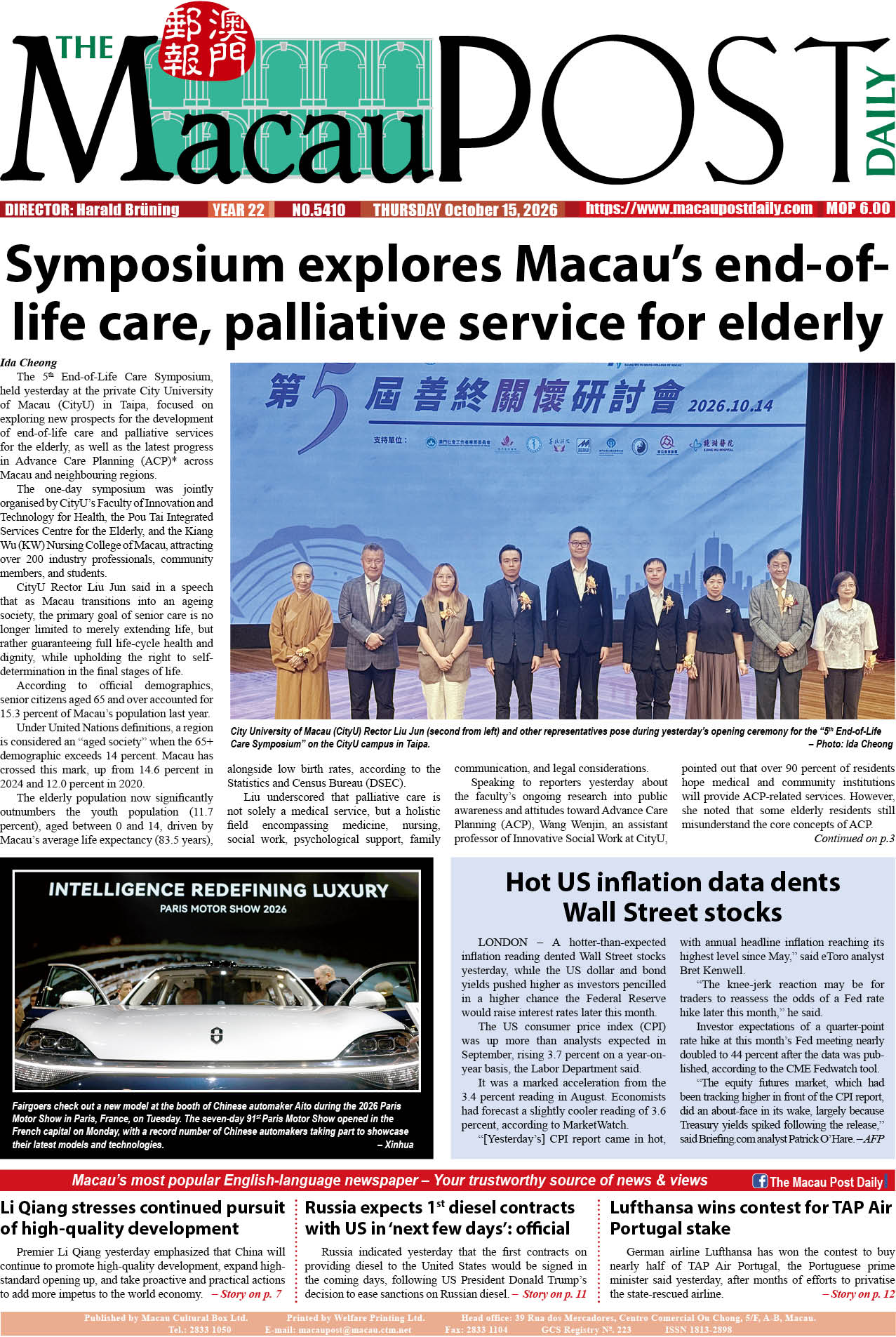


The Health Bureau (SSM) held a press conference yesterday to raise public awareness of common springtime infectious diseases, during which Chang Tam Fei, director of the emergency department of the public Conde de São Januário Hospital Centre, quoted the latest surveillance data as saying that influenza viral activity in Macau has dropped slightly from its peak over the past week, but enteroviruses have been on the rise lately, and are even expected to increase further in the spring.
Macau entered its influenza peak season in December last year, predominantly driven by the Influenza A virus. In the first week of this year, there was a significant increase in the number of attendances at the emergency clinics of the public Conde de São Januário Hospital Centre and private Kiang Wu Hospital, with nearly 1,400 attendances – children accounted for 300 attendances, according to the press conference. It outlined the trends in Macau’s influenza virus positivity*, indicating that it peaked at 29.1 percent in the fourth week of the year and then decreased to 13.4 percent over the past week, a drop of 31.0 percent from the previous week’s positivity rate of 19.4 percent.
Yesterday’s press conference was also addressed by Ieong Chon Kit, an official from the Health Bureau’s Communicable Disease Prevention and Control Division; as well as Wong Fong Ian, chief of the Paediatrics Department at Conde de São Januário Hospital Centre.
Regarding influenza-like illness clusters, the press conference noted that the bureau has so far recorded 29 cases this year, involving 206 individuals, primarily in primary and secondary schools, of which 17 cases were reportedly caused by Influenza A viruses.
Dr Chang referenced health surveillance data indicating a slight decrease in influenza activity in Macau following the Chinese New Year (CNY) holiday. However, he was quick to underline that influenza was still expected to remain in the community this month.
According to the bureau, the average daily number of attendances at the two hospitals for influenza-related emergencies over the past week stood at 82, consisting of about 44 adults and 38 children each day.
Dr Chang also said that the influenza vaccination campaign in Macau was “very active”, with a peak of more than 3,000 vaccinations per day in January: “…the number of inoculations has recently decreased slightly, but the daily average has been around 1,000 for some time”. He added that government-purchased vaccines were effective in preventing the epidemic strain of H1N1.
Influenza has declined slightly since its peak and the number of attendances at emergency clinics has been on a steady downward trend, but, according to Dr Chang, it has risen slightly in the last week, pointing out: “Our [current] attendance figures should resemble those prior to the Chinese New Year holidays”.
Enteroviruses** on the rise
Dr Ieong said that with the gradual rise in temperature in spring, “all kinds of gastrointestinal discomforts are on the rise”, citing health surveillance figures as pointing out that there has been an increase in gastroenteritis cases since December last year, mainly due to food poisoning caused by improper food processing and storage, as well as gastrointestinal infections, with the most common viruses being norovirus and rotavirus – the former, according to Dr Ieong, is highly contagious, but its symptoms are typically mild, including gastrointestinal discomfort, coughing, vomiting, stomach ache and mild fever that can be gradually recovered from within one to five days.
According to the press conference, so far this year, the bureau has received 15 reports of mass gastroenteritis, affecting about 178 people, including food-borne gastroenteritis, as well as outbreaks in educational institutions and social welfare facilities, where viral gastroenteritis is more prevalent but generally present with milder symptoms.
Dr Ieong also cited the bureau’s information on mandatory reporting of diseases, saying that there hasn’t been any significant increase in cases of norovirus, rotavirus, salmonella or bacterial food poisoning, among which, specifically, the average number of norovirus cases stood at 10 per week, lower than the 14 cases per week reported during the same period last year; while the average number of rotavirus cases and salmonella cases remained stable at three per week and one per week respectively, both consistent with the previous year.
On childhood infections, Dr Wong said that between January and last Saturday, the central laboratory detected 82 samples of gastrointestinal viruses, among which about 37 were norovirus, a relatively high in number, while 22 were rotavirus.
The press conference highlighted residents’ need to take preventive measures against infectious diseases in spring, including maintaining a balanced diet, increasing the intake of fruit and vegetables, and exercising regularly to strengthen immunity; in terms of personal hygiene, washing hands frequently, especially before meals and after going to the toilet, and covering mouth and nose with one’s elbow or a tissue when coughing or sneezing to avoid direct contact; in terms of environmental hygiene, cleaning and disinfecting one’s living environment on a regular basis and keeping it well ventilated with special attention to hygiene in the kitchen and dining area by keeping food storage safe.
Dr Chang pointed out that the overall distribution of cases in spring was slightly different between adults and children, with adults being more tolerant than children, so parents should pay close attention to their kids’ health conditions and any symptoms they may exhibit.
* Influenza virus positivity refers to the proportion of laboratory tests that confirm the presence of the influenza virus in samples taken from individuals suspected of having an influenza-like illness (ILI). This metric is commonly used to monitor influenza activity during flu seasons and is expressed as a percentage. – DeepSeek
** Enteroviruses are small, non-enveloped, and highly contagious. They are known to cause a wide range of illnesses in humans, ranging from mild respiratory or gastrointestinal symptoms to severe neurological and systemic diseases. – DeepSeek
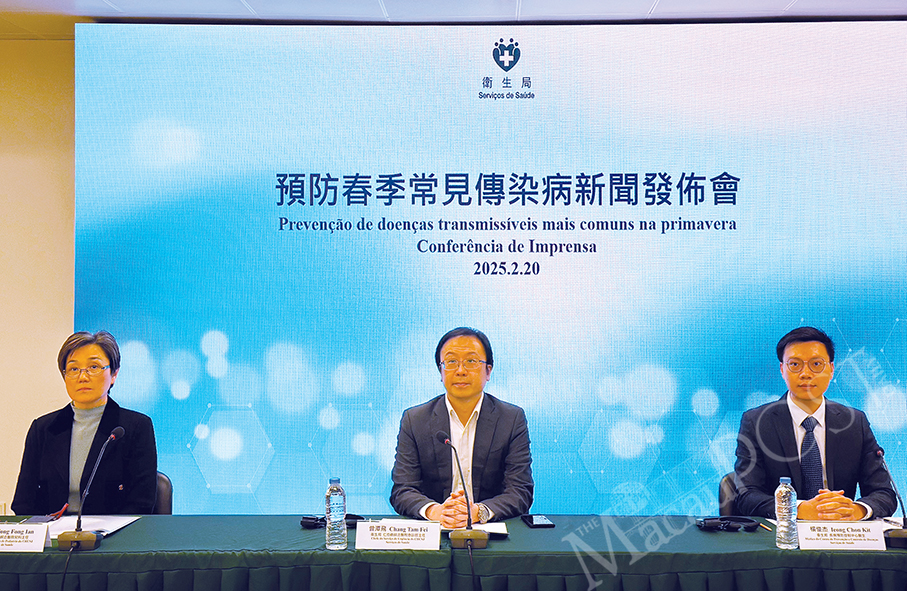
Chang Tam Fei (centre), director of the emergency department of the public Conde de São Januário Hospital Centre; Ieong Chon Kit (right), an official from the Health Bureau’s Communicable Disease Prevention and Control Division; and Wong Fong Ian, chief of the Paediatrics Department at Conde de São Januário Hospital Centre. pose during yesterday’s press conference about common springtime infectious diseases. – Photo: Yuki Lei