

Commentary by Tony Wong
The government’s upcoming project to revitalise the Tamagnini Barbosa Market is good news for many residents. The plan, scheduled to begin in the first quarter of next year, will convert the entire first floor into a cooked food centre. Based on a recent visit and the recently announced project details, I believe this new facility will significantly enhance the well-being of those living in the neighbourhood.
The Tamagnini Barbosa district in the northern peninsula is known as Toi San in Cantonese.
While the wet-market municipal complex in the Toi San district currently has several stalls selling local favourites on the ground floor, it lacks a dedicated cooked food centre with a dining area. Earlier this month, after taking photos of the market, I bought a peanut-stuffed egg waffle from one of these stalls. With no seating available, I had to eat it in the street – an experience that was far from ideal.
This made me realise that the absence of seating discourages many people, including myself, from buying food there, as we prefer to sit down to eat.
Toi San Market opened in 2005.
Currently, only four of Macau’s eight wet markets have cooked food centres: those at the S. Domingos, S. Lourenço, Iao Hon, and Patane municipal complexes. Unlike the first three, the Patane facility is officially classified as a “food court” due to its high-end design.
The upcoming revamp of Tamagnini Barbosa Market, details of which were announced earlier this month, is the latest project demonstrating the government’s commitment to revitalising the city’s wet markets. The Municipal Affairs Bureau (IAM) is the public entity tasked with this management.
The bureau has made steady progress in its campaign. This is evidenced by the renovated Horta da Mitra Market, which reopened in January last year; the revamped Red Market (officially known as Almirante Lacerda Market), which resumed operations in May last year; and the upgraded Patane cooked food centre, which reopened as a “high-class harbour-view” food court in April last year.
Moreover, the Taipa Market is currently being revamped to convert its first floor into a dining space with 19 stalls for light meals or cultural and creative products. This project, which includes a new rooftop café, is scheduled for completion before the end of this year.
IAM officials indicated earlier this year that the S. Domingos wet market in the city centre will likely be the next for revitalisation after Tamagnini Barbosa Market.
150-seat cooked food centre with 16 stalls
After informing public broadcaster TDM about the project last month, the bureau held a press conference earlier this month to announce the details.
There are currently 23 stalls selling fresh food and traditional groceries across the market’s two floors, plus nine stalls selling local delicacies on the ground floor. IAM officials acknowledged that many stalls in the market are currently vacant.
The revamp will convert the entire first floor into a cooked food centre with 16 stalls, while the entire ground floor will be dedicated to selling fresh food and traditional groceries. The ground floor will be reconfigured to house 23 stalls, operated by the current stallholders. As the total number of stalls will be reduced, their sizes will be enlarged.
The current nine stalls selling local delicacies will be relocated to the new cooked food centre on the first floor. The other seven stalls will be allocated to new operators through a public tender. The centre will have around 150 seats with various table types.
After the renovation, stalls selling the same types of fresh food will be grouped together. According to the project’s floor plan, the 23 ground-floor stalls will comprise: one beef stall, one frozen meat stall, two pork stalls, six fish stalls, three chilled food stalls, four vegetable stalls, two fruit stalls, two tofu and bean sprout stalls, and two traditional grocery stalls.
IAM officials also noted that the new fish stalls will be designed to separate customer areas from logistics areas.
The market currently has two lifts; the renovation will install a third. All three will be barrier-free after the revamp, and a nursing room will be added to the cooked food centre.
Cooked food centre to open in Q3 2026, fresh food stalls to reopen in early 2027
The revamp will be carried out in two stages. The first stage, renovating the first floor for the cooked food centre, is scheduled to start in the first quarter of next year and be completed in the third quarter. During this time, stalls on the ground floor will remain open, while the fresh food stalls from the first floor will be relocated downstairs.
During my visit earlier this month, preparatory work was already underway on the ground floor to facilitate this move before the first stage begins.
After the cooked food centre opens in the third quarter of next year, the second stage will begin, involving the renovation of the ground floor. This stage is expected to be completed in the first quarter of 2027. Stallholders can choose to suspend their business during this time, but IAM will arrange temporary stalls in a yet-to-be-determined location for those who wish to continue operating.
Food court or not?
Lastly, the artist’s rendition presented earlier this month shows that the future cooked food centre in Toi San will have very different décor to the existing centres at S. Domingos, S. Lourenço, and Iao Hon. In fact, it appears quite similar to the Patane food court.
This raises the question: will the bureau eventually classify the new facility at Tamagnini Barbosa Market as a “food court” before its opening?
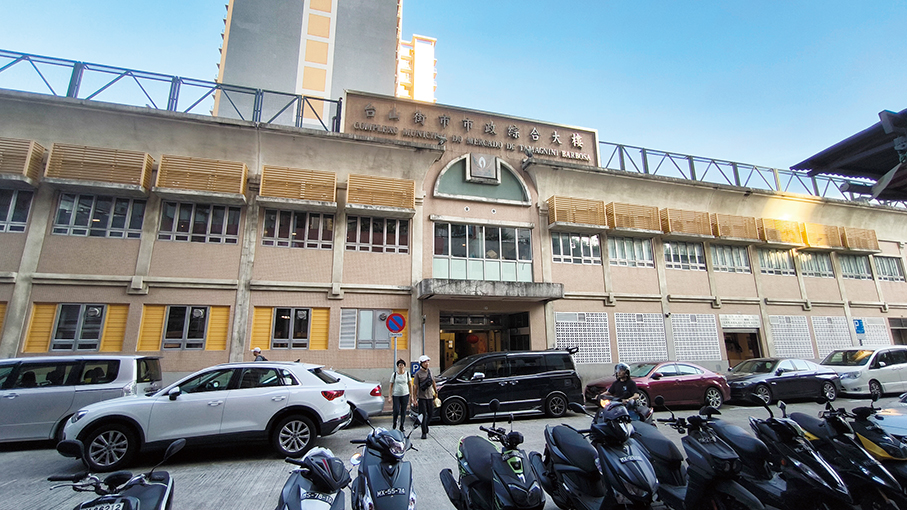
This photo taken earlier this month shows the Tamagnini Barbosa Market Municipal Complex, located in the southern part of Toi San district, north of the now-defunct greyhound racetrack (Yat Yuen Canidrome).
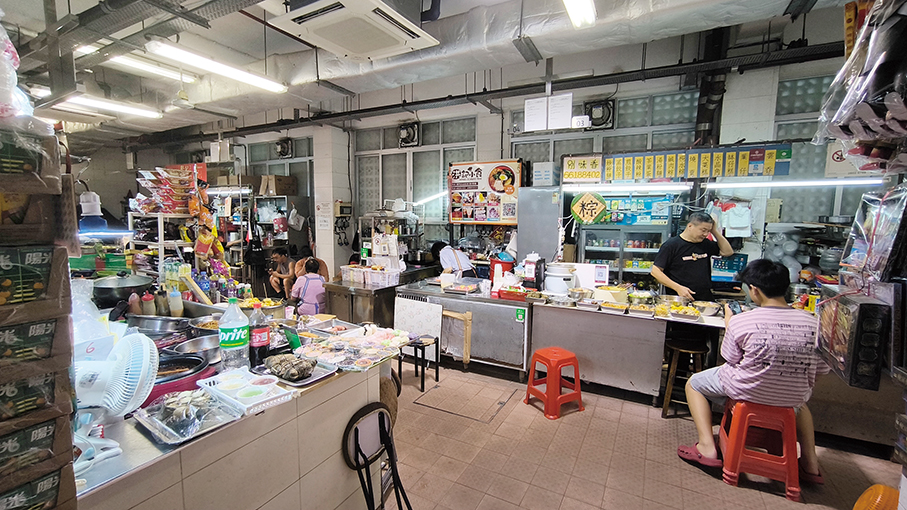
A stallholder works at his stall selling local favourites on the ground floor of Tamagnini Barbosa (Toi San) Market earlier this month. – Photos: Tony Wong