

According to Macau’s total number of crimes reported in the first nine months of last year, announced by the Office of the Secretary for Security (GSS), the number of suspected domestic violence cases rose by 24 year-on-year to 80.
While cases classified as suspected “crimes of domestic violence” were only a few, there were 59 cases categorised as “crimes against physical integrity” involving family conflicts during the same period.
The Post yesterday interviewed Wong Lei Lei, who heads Lai Yuen (“Garden of Encouragement”) Shelter run by the Macau Women’s General Association (commonly known as Fu Luen), about the ongoing effort to prevent domestic violence.
Wong said that the decline in filed cases may be attributed to the effectiveness of public awareness campaigns and support measures under the Law for the Prevention and Combating of Domestic Violence.
However, she also called for the authorities to place focus on households at high risk of domestic violence
Wong pointed out that the law has enabled more victims to realise that they can access financial, medical, housing, and employment support through cross-departmental assistance, encouraging them to seek help proactively.
Additionally, the working group of domestic violence prevention led by the Social Welfare Bureau (IAS), in conjunction with its 11-year ongoing promotional efforts, has strengthened community outreach and resource dissemination, Wong said.
However, Wong pointed out, domestic violence prevention and intervention efforts still face multiple challenges. These include financial pressures exacerbating family conflicts, increasingly complex family issues paired with low willingness to seek help, perpetrators using technology to stalk and monitor victims, and lingering societal attitudes such as “family shame should not be exposed,” which leads many victims to endure abuse for extended periods of time before seeking assistance, Wong said.
She particularly noted that support services for perpetrators are currently largely voluntary, adding that if the perpetrator refuses to take part in counselling, it becomes difficult for the authorities to continuously monitor and address the associated risks.
Wong said that in many parts of Asia, domestic violence incidents often go unreported.
Beyond the traditional notion that “family shame should not be exposed,” this phenomenon involves multiple social and cultural factors. Influenced by traditional beliefs, many women feel compelled to maintain an “intact family,” often enduring abuse for the sake of their children, Wong said.
Male victims may be constrained by societal expectations such as “men should not shed tears lightly,” Wong said, pointing out that male victims tend to fear that seeking help could undermine their perceived family roles and presence, which lowers their willingness to reach out.
Wong also said that some victims in need harbour reservations about seeking professional assistance, worrying about being labelled as “having issues” or “being ill.” Stigma often deters them, leading them to confide only in friends or relatives. They may only take action when they experience significant physical or psychological harm or when severe situations such as child violence arise, resulting in delayed help-seeking, Wong said.
Future priorities will focus on enhancing public awareness and vigilance regarding domestic violence through community outreach, training and promoting “ambassadors”*, and leveraging online platforms, according to Wong, added that the efforts aim to encourage high-risk families to seek help early, thereby preventing the occurrence or escalation of violence.
*The term “ambassador” can also refer to someone who promotes a certain cause, often in a non-official capacity. In this context, it usually describes a person who advocates for or represents a specific mission, organisation, or initiative, like a “youth ambassador” for education or an “environmental ambassador.” This usage highlights their role in raising awareness and promoting that cause. – Poe
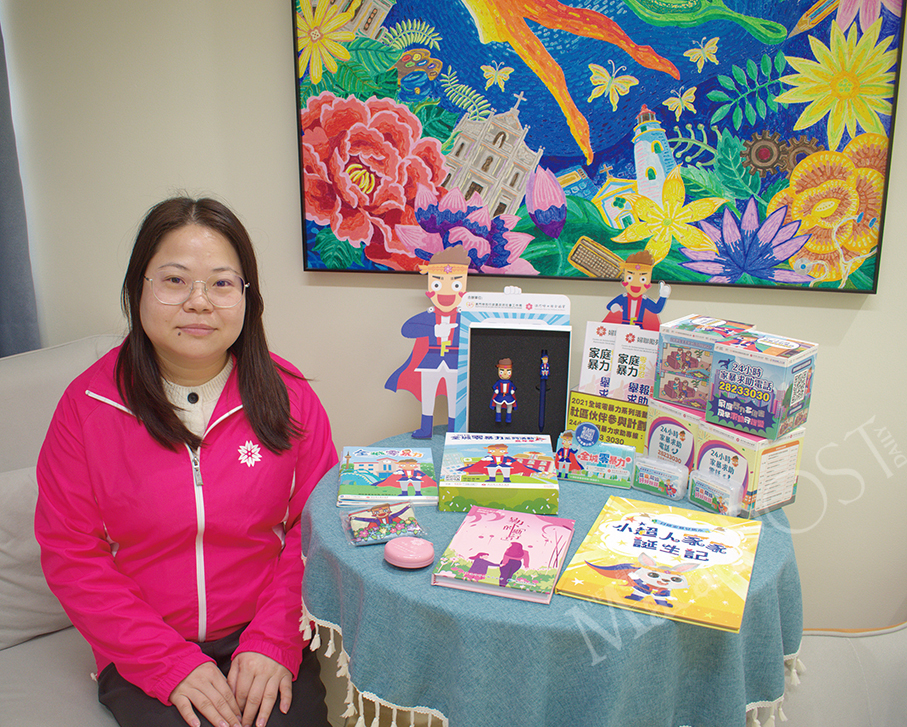
The Macau Women’s General Association’s (Fu Luen) head of its Lai Yuen Shelter, Wong Lei Lei, poses next to the association’s anti-domestic violence promotional items before yesterday’s Post interview at the Fu Luen Family and Community Service Centre. – Photo: Armindo Neves