

Investigation conducted by the Joint Research Laboratory in Advanced Technologies for Smart Cities of the public Macao Polytechnic University (MPU) and Portugal’s University of Coimbra (UC) has received the Best Student Paper Award at the 24th International Conference on Web-Based Learning (ICWL), according to a recent MPU statement.
ICWL was founded by the Hong Kong Web Society and has been held in various countries and regions since 2002, including the Chinese mainland, Australia, Germany, Italy, South Africa and Spain, the statement noted, adding that the 24th edition was hosted by the Hong Kong Polytechnic University (PolyU) under the theme “Advancing Educational Technology in the Age of AI”, focusing on how artificial intelligence (AI) can enhance teaching systems and promote personalised learning.
The award-winning study was presented by MPU PhD students Choi Wan-Chong from the Doctor of Philosophy in Computer Applied Technology programme and Choi Iek-Chong from the Doctor of Philosophy in Educational Technology and Innovation programme, the statement said
The research was supervised by Dean of the MPU Faculty of Applied Sciences Lam Chan-Tong and Prof. António José Mendes from UC, the statement added.
The research, titled “Explaining Student Performance Prediction and Generating Personalised Actionable Feedback Using Explainable Artificial Intelligence (XAI) with SHAP”, the study focused on student performance prediction and explainable AI in the field of educational technology, according to the statement.
The statement said that traditional predictive models in educational data mining can estimate student performance but often lack transparency, making it difficult to provide actionable guidance for teachers and students, adding that in order to address the issue, the research team proposed an innovative approach that integrates an optimised XGBoost algorithm with SHapley Additive exPlanations (SHAP)*.
By applying SMOTE-class** balancing and hyperparameter tuning, the model achieved improved performance across multiple indicators, enabling effective early prediction and identification of potential learning risks, the statement said.
A key feature of the study is its ability to generate personalised analytical reports for individual students, clearly identifying the factors influencing their academic performance, the statement noted, adding that this allows for tailored learning strategies and provides reference points for educational decision-making.
*SHAP (SHapley Additive exPlanations) is a game theory-based method used to explain the output of machine learning models. Its goal is to explain a prediction by computing the contribution of each feature to that prediction. It tells you, for a single prediction (e.g., why was this loan denied?), how much each feature (e.g., income, credit score, age) pushed the prediction away from the average. –DeepSeek
** SMOTE (Synthetic Minority Over-sampling Technique) is a data augmentation technique used to address class imbalance in machine learning. When you have a dataset where one class (the minority) has far fewer samples than another (the majority), a model will struggle to learn the minority class. SMOTE solves this by creating new, synthetic samples for the minority class, rather than simply duplicating existing ones. - DeepSeek
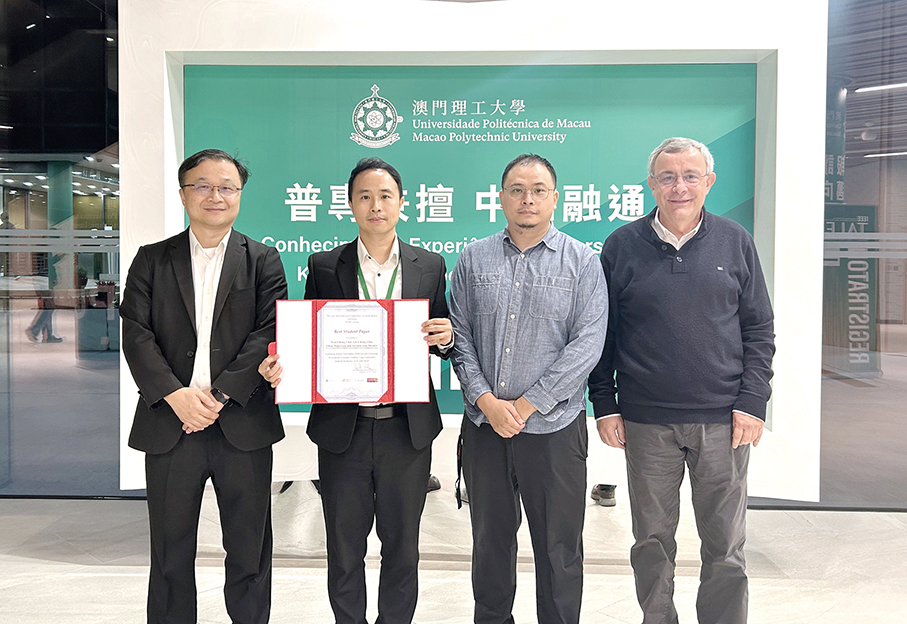
This undated handout photo provided by the public Macao Polytechnic University (MPU) recently shows MPU PhD students Choi Wan-Chong (second from left) and Choi Iek-Chong (second from right), alongside MPU Dean of the Faculty of Applied Sciences Lam Chan-Tong (first from left) and Portugal’s University of Coimbra (UC) Prof. António José Mendes, posing for an on-campus group photo after winning the International Conference on Web-Based Learning (ICWL) Best Student Paper Award.