

Macau’s Sheng Kung Hui Macau Social Services Coordination Office hosted a press conference on Friday about the findings of its surveys showing that young people spend more time on social media, from around 1.64 hours a day in 2022 to around 3.53 hours a day last year.
The press conference was held at its service centre in Fai Chi Kei. The two surveys are titled “Survey on Youth Digital Literacy and New Technology Application in Macau 2025” and “Building a Healthy Macau – Survey on Youth Health Awareness and Behaviour 2025”.
Sheng Kung Hui is the Anglican Church’s Cantonese name.
Both surveys aimed to gather data to support policy formulation and the development of appropriate youth support services, and to collaborate with the social service sector in building a healthy network for young people were conducted between June and September last year. They collected 952 and 932 valid questionnaires respectively from young people, aged between 13 and 35.
The findings show that young people’s self-assessed digital literacy awareness rose from 5.71 to 7.06 points (on a scale of 1.0 to 10). However, the findings also show that the scores remained relatively low in the categories of “use and management” and “digital ethics and cognition” of social media.
The survey also indicates that with the increasing use of AI tools, young people spend an average of 2.3 hours per week on them, commonly using platforms such as DeepSeek and ChatGPT. Notably, the findings also show that 68.2 percent of respondents were either unfamiliar with or had little understanding of “AI hallucinations”. *
Sheng Kung Hui representatives said at the press conference that young people lack sufficient awareness of the risks associated with generative AI and called for enhanced education on the inherent risks of such applications.
The findings also show that while around 39 percent of young people experience a relatively high level of loneliness, 22.5 percent said they engage in conversations with AI during negative emotional periods, with about 35 percent of the latter finding such interactions helpful.
The representatives also said that AI chat is not a substitute for professional counselling and should be approached cautiously in terms of its role in emotional support, encouraging individuals to seek help from trained professionals.
In terms of health, the findings show that 65 percent of respondents reported experiencing sleep disturbances, 60 percent engage in physical exercise on a weekly basis, averaging 3.06 hours per week. Among adolescents aged 13 to 18, some 50.4 percent reported “often or always” looking at smartphone screens while eating.
The organisation said a positive correlation was found between digital literacy and AI literacy, with higher levels in both areas associated with lower levels of anxiety and depression.
The challenges facing young people today are complex, intersecting digital life with physical and mental health, the representatives said, adding that it would be advisable to simultaneously advance efforts in three areas, namely enhancing digital literacy, focusing on health promotion, and strengthening support networks.
* AI hallucinations are instances when an artificial intelligence system (typically a generative model) produces information that is incorrect, misleading, or fabricated, while presenting it as if it were true or factual. – Poe
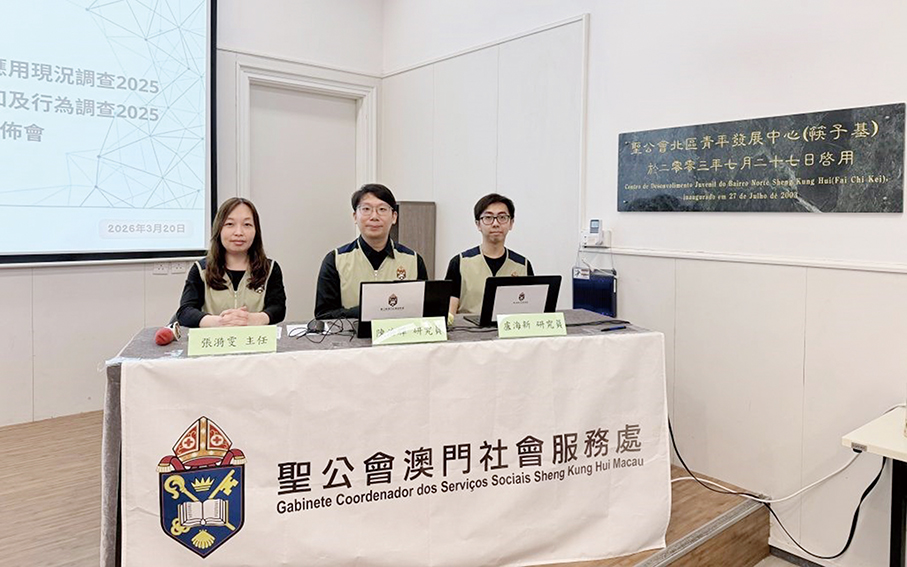
Sheng Kung Hui (SKH) Survey Research Centre Chief Cheong I Man (left) and two survey analysts look on during Friday’s press conference about its surveys at SKH’s service centre in Fai Chi Kei. – Photo courtesy of SKH