

The government announced yesterday that this year’s edition of its annual insurance scheme for financial losses suffered by local small- and medium-sized enterprises (SMEs) caused by natural disasters has introduced one new coverage, according to which an insured company can claim a payout equivalent to 10 percent of their policy’s insured sum after a No.10 typhoon signal is hoisted for at least 10 hours, even though they have not incurred any financial losses.
As previously, this year’s insurance scheme will be run with a subsidy provided for eligible companies to pay part of the annual premium of their policy.
The insurance scheme is run and overseen by the Macau Monetary Authority (AMCM), while the subsidy scheme is operated by the Economic and Technological Development Bureau (DSEDT) through its Industrial and Commercial Development Fund (FDIC).
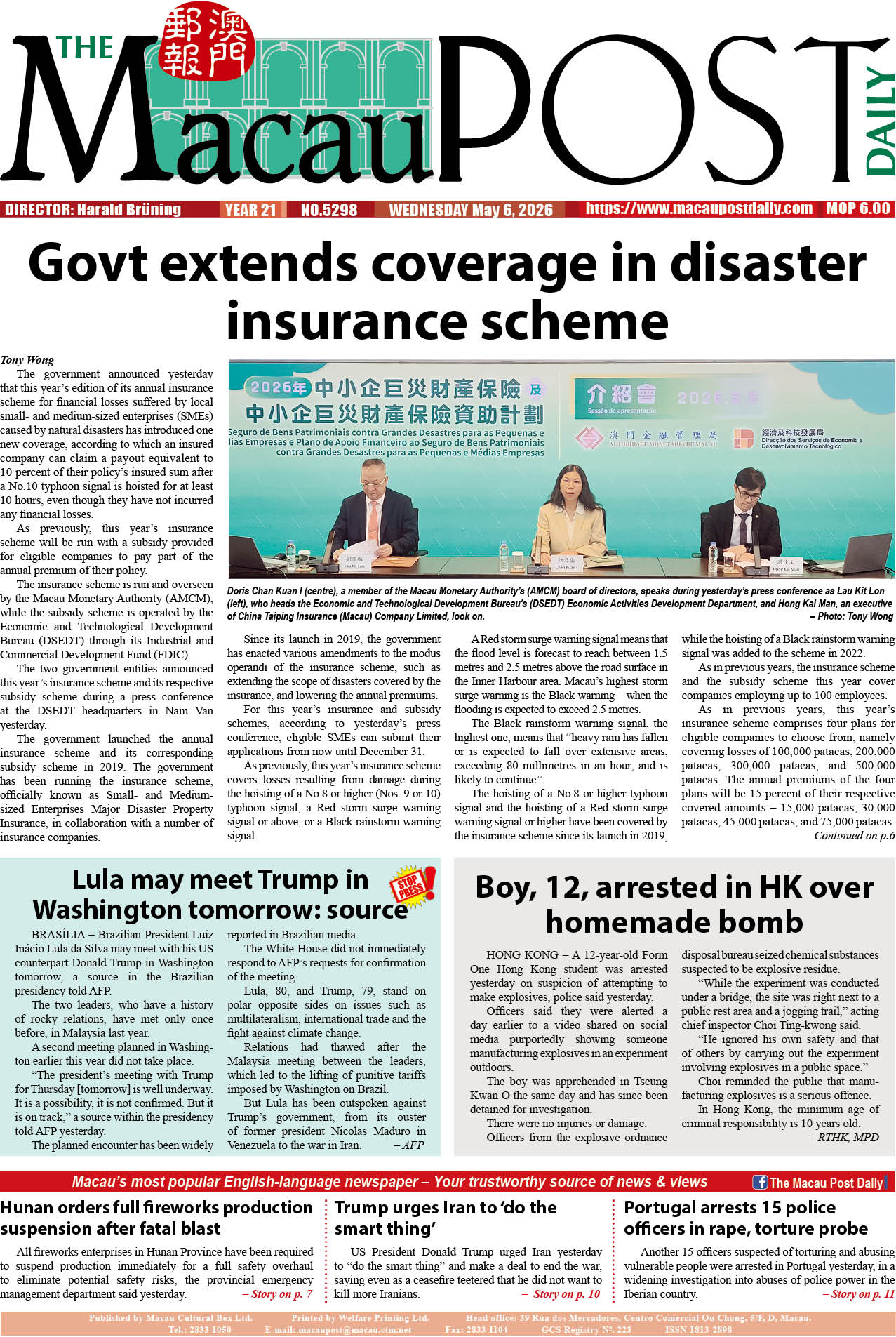
The two government entities announced this year’s insurance scheme and its respective subsidy scheme during a press conference at the DSEDT headquarters in Nam Van yesterday.
The government launched the annual insurance scheme and its corresponding subsidy scheme in 2019. The government has been running the insurance scheme, officially known as Small- and Medium-sized Enterprises Major Disaster Property Insurance, in collaboration with a number of insurance companies.
Since its launch in 2019, the government has enacted various amendments to the modus operandi of the insurance scheme, such as extending the scope of disasters covered by the insurance, and lowering the annual premiums.
For this year’s insurance and subsidy schemes, according to yesterday’s press conference, eligible SMEs can submit their applications from now until December 31.
As previously, this year’s insurance scheme covers losses resulting from damage during the hoisting of a No.8 or higher (Nos. 9 or 10) typhoon signal, a Red storm surge warning signal or above, or a Black rainstorm warning signal.
A Red storm surge warning signal means that the flood level is forecast to reach between 1.5 metres and 2.5 metres above the road surface in the Inner Harbour area. Macau’s highest storm surge warning is the Black warning – when the flooding is expected to exceed 2.5 metres.
The Black rainstorm warning signal, the highest one, means that “heavy rain has fallen or is expected to fall over extensive areas, exceeding 80 millimetres in an hour, and is likely to continue”.
The hoisting of a No.8 or higher typhoon signal and the hoisting of a Red storm surge warning signal or higher have been covered by the insurance scheme since its launch in 2019, while the hoisting of a Black rainstorm warning signal was added to the scheme in 2022.
As in previous years, the insurance scheme and the subsidy scheme this year cover companies employing up to 100 employees.
As in previous years, this year’s insurance scheme comprises four plans for eligible companies to choose from, namely covering losses of 100,000 patacas, 200,000 patacas, 300,000 patacas, and 500,000 patacas. The annual premiums of the four plans will be 15 percent of their respective covered amounts – 15,000 patacas, 30,000 patacas, 45,000 patacas, and 75,000 patacas.
The 500,000-pataca insurance plan was added to the scheme in 2023, when the annual premiums were also lowered to 15 percent of the respective policy’s insured sum from the previous 25 percent.
As in previous years, this year’s insurance scheme will continue to offer a discount on the premium for companies that renew their policy, provided that they have never made a claim on the policy.
Those who renew their policy for the first year will enjoy a 20 percent discount, while those who renew their policy for the second and third year will have a 25 percent and a 30 percent discount respectively. Those who renew their policy for the fourth year or above will enjoy a 35 percent discount on the annual premium.
This year, according to yesterday’s press conference, the amount of the subsidy will cover 70 percent of the annual premiums of the four plans, but with a maximum of 35,000 patacas. Therefore, after receiving the subsidy, eligible companies will need to pay 4,500 patacas, 9,000 patacas, 13,500 patacas, and 40,000 patacas for the four plans per year respectively.
According to the press conference, the government has raised the subsidy to 70 percent of the annual premiums this year from the previous 50 percent (with a maximum of 30,000 patacas).
Six insurance companies have joined this year’s insurance scheme.
In the four plans, the insured company, in case of financial losses, can make a claim equivalent to the actual losses resulting from damage during the hoisting of a No.8 or above typhoon signal, a Red storm surge warning signal or above, or a Black rainstorm warning signal. According to yesterday’s press conference, this year’s edition of the insurance scheme has introduced one new coverage, according to which an insured company can make a claim equivalent to 10 percent of their policy’s insured sum after a No.10 typhoon signal is hoisted for at least 10 hours, even though they have not incurred any financial losses.
For instance, in such circumstance, a company that has joined the 300,000-pataca insurance plan can claim 30,000 patacas.
If a company has incurred financial losses after a No.10 typhoon signal is hoisted for at least 10 hours, it can choose to claim a payout equivalent to the actual losses, or a payout equivalent to 10 percent of its policy’s insured sum, whichever is higher, according to the press conference.
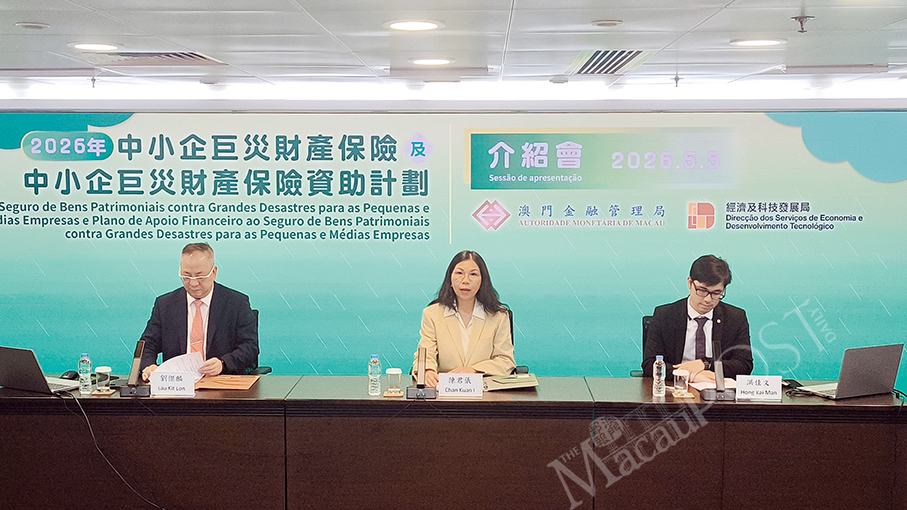
Doris Chan Kuan I (centre), a member of the Macau Monetary Authority’s (AMCM) board of directors, speaks during yesterday’s press conference as Lau Kit Lon (left), who heads the Economic and Technological Development Bureau’s (DSEDT) Economic Activities Development Department, and Hong Kai Man, an executive of China Taiping Insurance (Macau) Company Limited, look on. – Photo: Tony Wong