

Commentary by Sam-Kee Cheng* and Elias Jabbour**
To further our research on the political economy of Sino-Brazilian relations, one of us made a visit to the Service Centre for Economy and Trade between China and Portuguese/Spanish-speaking countries (CECPS) to learn about the work of this newly established centre in Hengqin and the uptake so far. CECPS’s goal is to construct a “one-stop” integrated service platform that connects China with these countries and to provide practical assistance and tailored and efficient services for Chinese enterprises to expand business overseas as well as for foreign enterprises to expand into China, utilising the domestic markets and the comprehensive supply chain in China. In less than a year, the centre has received enquiries from over 300 enterprises and have signed cooperative memorandum with over 40 of them. With the growing interest and demand for services in Brazil, CECPS has opened a permanent office in Brazil to better serve the business community there.
As researchers in the political economy of China’s development and overseas investments, this centre looks like another exemplary work of the socialist market economy which is steered by planning (the new strategic positioning of “Macao+Hengqin” as stated in the guidance documents) and government funding (RMB1 billion of CECPS Investment Fund provided by the Government of the Guangdong-Macao In-depth Cooperation Zone and RMB 30 billion Hengqin Industrial Investment Fund) while the service centre is operated as a non-governmental entity on the market.
As mentioned by the colleagues who spoke with me in the centre themselves, there is no comparable service provider of this kind in the world. As a non-profit organisation with government resources and connections, it can focus on the needs of the enterprises and give the best advice, free from concerns for commission but with the knowledge of the most up-to-date economic and trade policies and direct communications with relevant departments and organisations both in China and overseas. The service centre is not driven by profit but the fulfilment of state’s strategy. It is part of China’s innovative planning which has matured over time with state resources as the base, including highly efficient organisations feeling the pulse of the global market, for the next stage of development for all types of enterprises, especially those aim to develop a competitive edge that matches with industrial development planning.
As the Macao Special Administrative Region Government plans to establish a MOP20 billion patacas (US$2.56 billion) government guidance fund for the promotion of economic diversification which aims to bring long-term development and more diversified employment opportunities, there is good reason for the guidance fund and service centre to work together to support new industries as well as expanding the services in human resources, market research, business matching and financing, and resolving the operational issues for overseas business expansion.
By utilising the state-led initiative and combining the development of science and technology with soft services, it creates the need for a wide pool of talents and an opportunity for MSAR government to reconstruct the human infrastructure fit for the high-quality development that generates economic, social, and industrial transformation as specified in the 15th Five-Year Plan. As for the Macao economy which has been dominated by the gaming industry for decades and has led to relatively narrow career choices for the educated youths, the transformation is indeed much needed as diversification of job types and required skillsets in the job market will bring immediate impacts to the jobseekers and ripple effects to the society as a whole. A more equitable and sustainable development of Macao will generate support from below as the benefits of such transformation will be widely distributed.
This is the same for Brazil. It is important to enhance the economic relationship with China and at the same time diversify the bilateral trade not just in agribusiness but in a more wide range of businesses and services to offer more job opportunities for the Brazilian population, especially the younger generations which grew up in the neoliberal era with broken manufacturing, poor public services and infrastructure and the dominance of oligarchies in the economy as permanent features. Economic and trade relations with a strong economic power which can lead to developmental outcomes are badly needed in Brazil—to create a new experience of what economic growth can mean other than the depletion of resources and impoverishment with unskilled and low-paid jobs.
The Hengqin International Digital Talent Training Base in the CECPS which provides high quality training and accreditation programmes in information and communication technology (ICT) by the telecommunications giant Huawei is a good example to show that personnel upskilling and human infrastructure is also a key part of the bilateral relationship which brings better employment opportunities for the Brazilians. Over 1000 practitioners from Portuguese/Spanish-speaking countries completed the training last year. The training base will continue to run its accreditation programme annually. This helps to address the shortage of highly skilled technicians in Latin America and other countries which suffer “brain drain” due to outflow of skilled workers to Global North.
In our latest research project, we will look at the geopolitical economy as well as some case studies in the bilateral trade and investments. One of our objectives is to see how China’s plan for high-quality development impacted on Chinese overseas investments in Brazil. Macao is given a strategic position to be the liaison between China and the Portuguese/Spanish-speaking countries. CECPS is the perfect start for our investigative research and we look forward to working closer with the colleagues in the centre on our project.
*Sam-Kee Cheng
Research Assistant Professor, University of Macau
Associate Researcher of University of Macau Advanced Research Institute in Hengqin (HUMRI)
**Elias Jabbour
Associate Professor at School of Economics, State University of Rio de Janeiro
April 16, 2026
1Cheng, S-K., Jabbour, E. 2025. The Political Economy of Brazil–China Relations: Reprimarisation or Development Opportunities? Who Decides?. In: Leandro, F.J.B.S., Frogeri, R.F., Li, Y., Garcia, F.P., Silva, A.R.d.A. (eds) The Palgrave Handbook on Geopolitics of Brazil and the South Atlantic. Palgrave Macmillan, Singapore. https://doi.org/10.1007/978-981-95-1169-3_64.
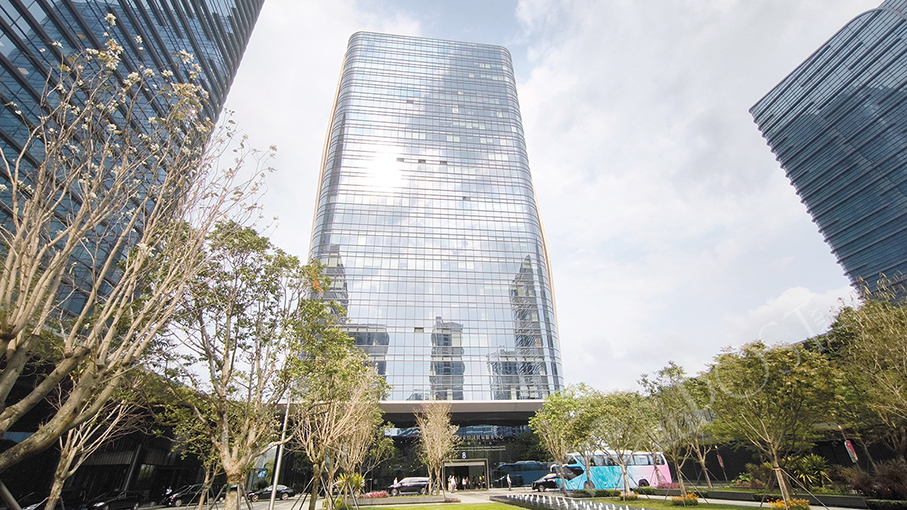
This file photo taken last month shows part of the Service Centre for Economy and Trade between China and Portuguese/Spanish-speaking Countries complex in Hengqin. – Photo: Tony Wong