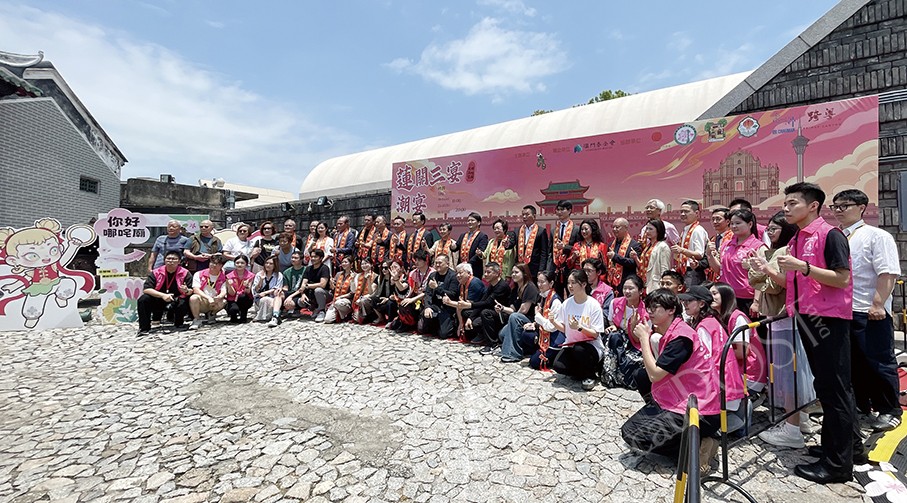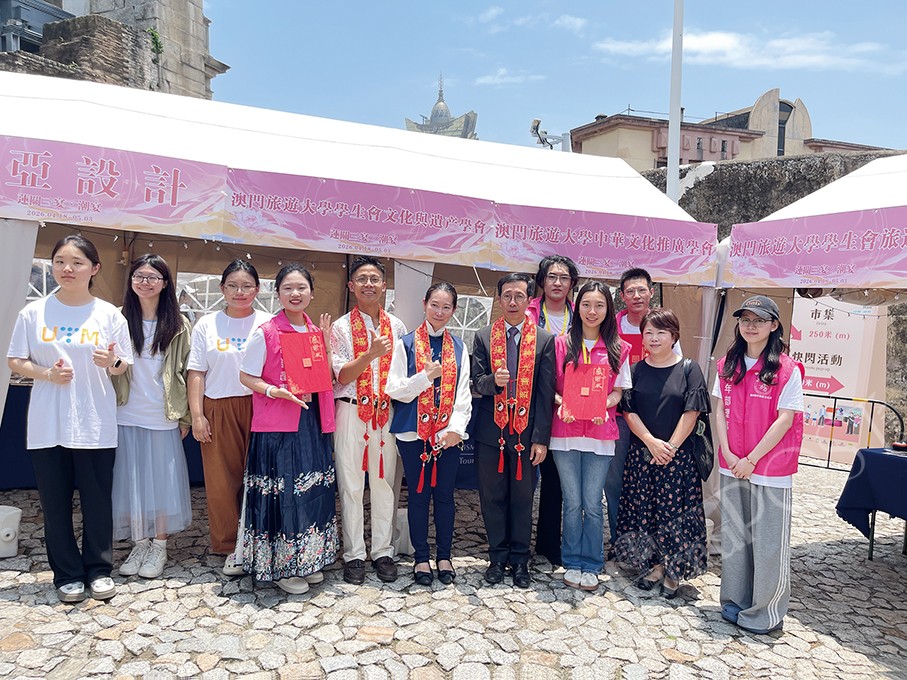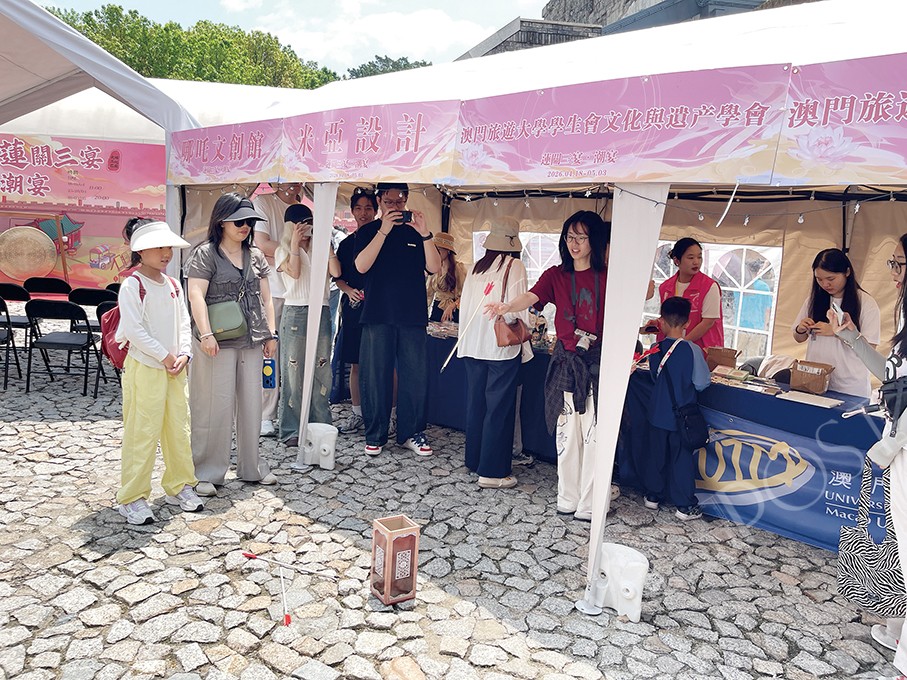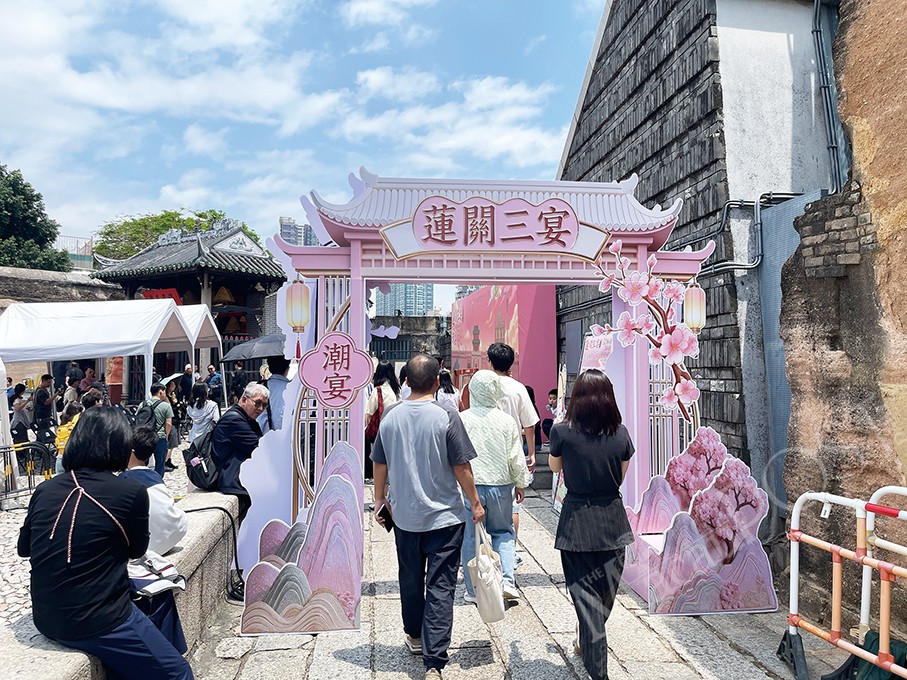


A seven-day Na Tcha themed market, titled “Lotus Door Three Banquets: China-chic Banquets”*, concluded on Sunday in front of the Na Tcha Temple near the Ruins of St Paul’s – both of which are listed by UNESCO as World Heritage sites.
Kuok Pak Yu, head of the Na Tcha Temple Association’s Youth Division, expressed hope that the event would be able to integrate intangible cultural heritage into daily life, showcasing the spirit of cultural transmission. According to Kuok, the “Three Banquets” concept aims to evolve with the times to spark creativity, carry forward ancient traditions to preserve social order, and fuse art to expand imagination.
Kuok made the remarks in a speech at the market’s opening ceremony outside the temple last Friday.
“The fusion of these elements is not only an innovation in form but a breakthrough in cultural boundaries,” Kuok said. “It allows centuries-old heritage to step out of history and into the modern day, enabling tradition to engage in a genuine dialogue with the present.”
Na Tcha, known in Putonghua as Nezha (哪吒), aka Nezha the Crown Prince (哪吒太子), is a protection deity in Taoism, Buddhism, and Chinese folk belief. Besides, Na Tcha, a prominent figure in Chinese mythology, is a divine hero whose origins are rooted in ancient Chinese folklore and religious traditions. According to the mythological narrative, Na Tcha was born during the Shang Dynasty (商朝, around 1600–1046 BCE), and his famed story is closely tied to the Investiture of the Gods (封神演义), a Ming Dynasty (1368-1644) novel set in that era.
Huangyang Weiyi, a student of the Macao Polytechnic University’s (MPU) Master of Interdisciplinary Arts programme, told the Post on the sidelines of the opening ceremony that he has developed two digital interactive systems to address challenges in transmitting Na Tcha belief traditions. Using 3D modelling, a virtual museum, and an interactive narrative game, his systems aim to transform historical legends into a visual experience.
“The systems break the spatial and temporal limitations of traditional processions,” Huangyang explained. “It allows younger generations to learn about the connection between Na Tcha and Macau through video games.”
Huangyang conducted 3D scans of physical artefacts, including statues, carvings, and ceremonial drums. He transformed these into modular visual exhibits within a virtual space, featuring adjustable viewing perspectives and an integrated quiz system.
The digital game, designed with a 2D workflow, recreates the historical memory of the Na Tcha Temple. Users navigate the site via avatars, interacting with non-player characters (NPCs) to learn about different historical periods. During the market, the system attracted a large number of visitors, including many children, injecting new vitality into heritage preservation.
Ku Kei Ieng, a lecturer at the Macao University of Tourism (UTM), told the Post she has volunteered for 18 years to promote the temple’s culture. Initially, she focused on translating cultural information into English for visitors and academic conferences.
She noted that most tourists walk downhill from the Ruins of St Paul’s towards the city’s main square, Largo do Senado, rarely turning towards Chi Lam Vai (Pátio do Espinho).
Pátio do Espinho (“Courtyard of the Thorn”) – Chi Lam Vai (茨林圍) in Cantonese – is a 400-year-old walled village that lies just a street away from the Na Tcha Temple, one of Macau’s two temples dedicated to the tutelary deity.
Ku pointed out that the patio is the only inhabited walled village remaining in Macau, surrounded by several distinctive temples. Ku said she hopes that the nearby Na Tcha Temple’s activities will guide visitors to explore these areas more deeply, moving beyond simple photo-taking to a true understanding of Macau’s unique culture.
Li Xintong, a member of the UTM Heritage Club, was responsible for guiding tours and introducing the architectural features of the temple during the three-day event. She noted that the Na Tcha Temple’s proximity to the Ruins of St Paul’s perfectly reflects Macau’s signature fusion of Chinese and Western cultures.
*The term “China-chic” refers to a popular trend in China that blends traditional Chinese cultural elements with modern, trendy aesthetics.
In the case of the “Three Banquets” fair, “China-chic Banquets” denoted the market as a banquet-style event – instead of a sit-down dinner, the “Three Banquets” referred to a themed market and cultural feast held in front of the Na Tcha Temple, inviting the public to “feast” on heritage, song, and dance. – Gemini, MPD
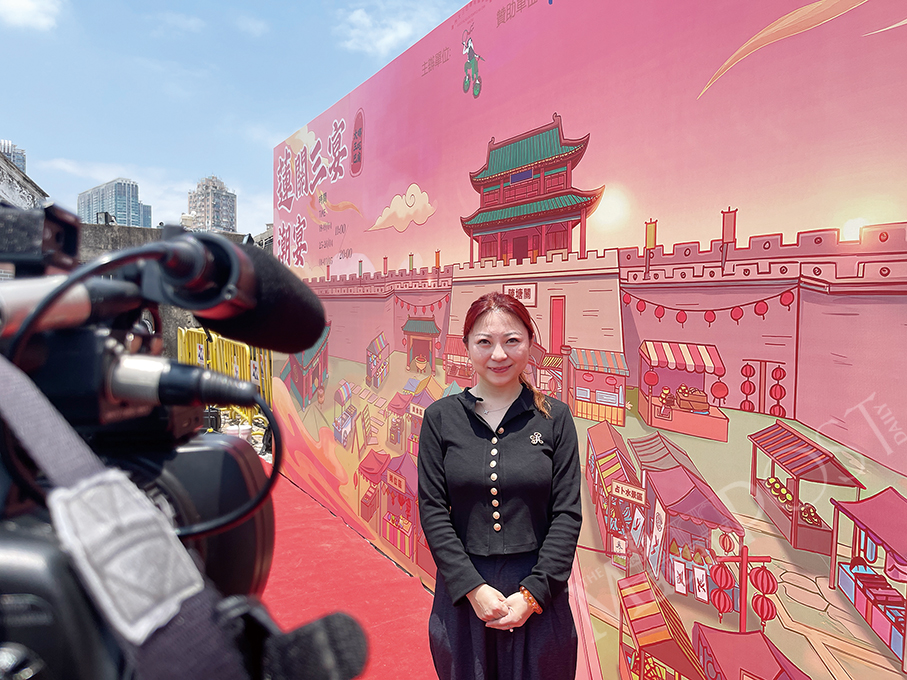
Kuok Pak Yu, head of the Na Tcha Temple Association’s Youth Division, poses during a media interview on the sidelines of the Na Tcha themed market’s opening ceremony in front of the UNESCO World Heritage-listed Na Tcha Temple last Friday. – Photos: Armindo Neves
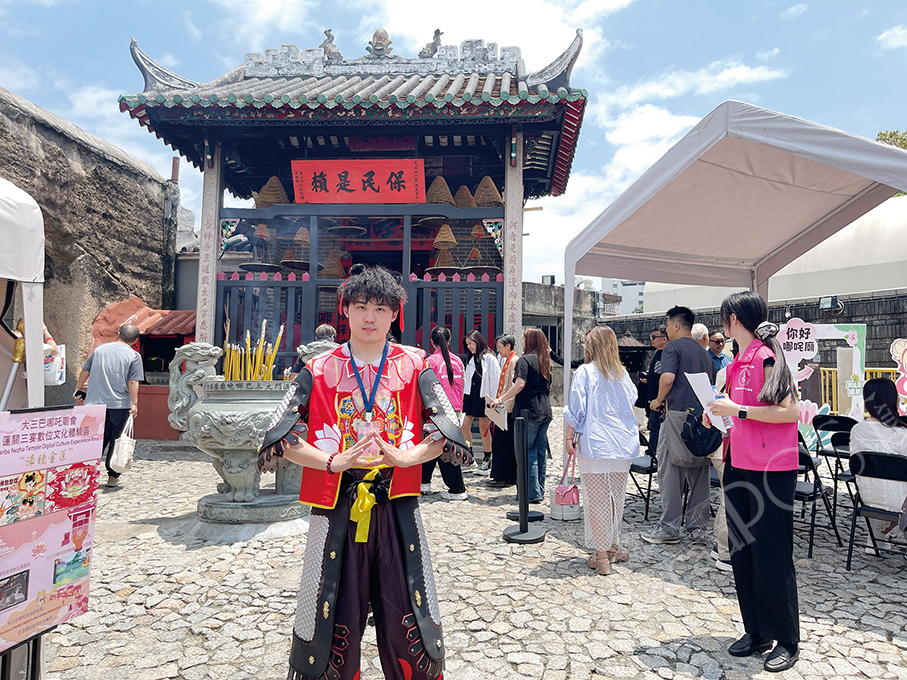
Huangyang Weiyi, a student of the Macao Polytechnic University’s (MPU) Master of Interdisciplinary Arts programme, wearing Na Tcha-related traditional garb, poses in front of the Na Tcha Temple last Friday.