


The government said yesterday that it has decided to draft amendments to the Labour Relations Law in line with its proposals raised during its public consultation process earlier this year, namely an increase in the number of days for private-sector employees’ statutory paid maternity leave, and an increase in the number of days for their statutory minimum paid annual leave.
The government also underlined yesterday that it is aiming to submit a bill amending the Labour Relations Law to the legislature within this year for debate, review and vote.
Labour Affairs Bureau (DSAL) Director Chan Un Tong made the remarks while speaking to reporters after a regular closed-door meeting of the Standing Council on Social Concerted Action.
The Standing Council on Social Concerted Action, headed by Macau’s chief executive, is a government-appointed consultative body tasked with advising the government on its labour policies.
Customarily, meetings of the council are chaired by Macau’s secretary for economy and finance. As the position of secretary for economy and finance was still vacant yesterday following Anton Tai Kin Ip’s resignation last month, yesterday’s meeting of the council, held at Government Headquarters, was chaired by Secretary for Administration and Justice Wong Sio Chak, on behalf of Chief Executive Sam Hou Fai.
The council consists of five business representatives and five labour representatives appointed by the government, as well as a number of government officials, one of whom is Chan.
Govt’s public consultation proposes 90-day maternity, annual leave up to 12 days
The Labour Affairs Bureau carried out a 45-day public consultation between January 31 and March 16 this year on proposed amendments to the Labour Relations Law, during which it was proposing to raise the number of days for statutory paid maternity leave in the private sector to 90 days from the current 70 days, while also proposing to raise the number of days for private-sector employees’ statutory minimum paid annual leave.
Currently, the number is six days for all private-sector employees with a minimum of one-year employment, regardless of their length of service. During its public consultation, the government was proposing to establish a system where the number of days for employees’ statutory paid annual leave will increase with their length of service, but with a maximum of 12 days.
The Labour Relations Law regulates the private sector’s employment. The public sector has its own employment regulations that are much more generous than those of its private counterpart.
Civil society ‘agrees’ with govt’s proposals
Speaking to reporters yesterday, Chan underlined that the government is aiming to submit a Labour Relations Law amendment bill to the legislature within this year as scheduled for debate, review and vote.
Chan also underlined that after assessing the around 10,000 opinions and suggestions gathered during the public consultation earlier this year, the government has concluded that members of Macau’s civil society generally agree with its proposals to raise the number of days for private-sector employees’ statutory paid maternity leave and the number of days for their statutory minimum paid annual leave.
Chan said that after gathering the opinions from the business and labour sectors during yesterday’s meeting, his bureau will now prepare and submit a report to the chief executive, proposing to amend the Labour Relations Law in line with its proposals raised during the public consultation.
When the Labour Relations Law came into force in 2009, the number of days for statutory paid maternity leave was 56 days. The number was raised to the current 70 days on May 26, 2020 when the law’s amended, current version took effect.
Private-sector employees with a minimum of one-year employment, regardless of local and non-resident workers (NRWs), are entitled to statutory paid maternity leave. The Labour Relations Law’s current version requires 63 days out of the 70 days of statutory paid maternity leave to be used immediately after the baby’s birth, while the mother can choose to take the remaining seven days before or after the birth.
During its public consultation earlier this year, the government was proposing to raise the number of days for statutory paid maternity leave to 90 days from the current 70 days. It was proposing to require 60 days out of the proposed 90 days of statutory paid maternity leave to be used immediately after the baby’s birth, while the mother can choose to take the remaining 30 days before or after the birth.
Govt proposes longer annual leave
Concerning the number of days for private-sector employees’ statutory minimum paid annual leave, the government was proposing during its public consultation earlier this year that employees with up to two years of service for the same employers would continue to be entitled to six days of paid annual leave, with those with their length of service ranging between two and four years to be entitled to seven days of paid annual leave; those working for the same employers between four and six years to be entitled to eight days of leave; those working between six and eight years to be entitled to nine days of leave; those working between 8 and 10 years to be entitled to 10 days of leave; those working between 10 and 12 years to be entitled to 11 days of leave; and those working for the same employers for at least 12 years to be entitled to 12 days of paid annual leave.
After the Labour Relations Law’s current version took effect on May 26, 2020, the government ran a three-year transition period during which the respective employers were only required to pay at least 56 days out of the 70 days of statutory paid maternity leave, while the remaining up to 14 days was paid by the government.
After the three-year transition period ended on May 25, 2023, the government once again launched a scheme, on a provisional basis, subsidising eligible employers’ payments of 14 days of maternity leave. Under the scheme, which is now running until December 31 this year, eligible employers must pay mothers the whole 70-day maternity period first before filing an application to the Labour Affairs Bureau to receive a subsidy of 14 days of maternity leave.
The current subsidy only applies to local female employees, because of which the employer of a mother who is a non-resident worker (NRW) still needs to pay the whole 70-day maternity period.
During its public consultation earlier this year, the government was proposing that it would continue to subsidise eligible employers’ payments of maternity leave after the number of days for statutory paid maternity leave is raised to 90 days. The government was proposing that eligible employers could apply for a subsidy of up to 20 days of maternity leave.
Also speaking to reporters after yesterday’s meeting, Kuong Chi Fong, a labour representative of the council, said that the labour sector agrees with the government’s proposals raised during its public consultation to raise the number of days for private-sector employees’ statutory paid maternity leave and the number of days for their statutory minimum paid annual leave.
Also speaking to reporters, Andrew Chan Chak Mo, a business representative of the council, said that the business sector also generally agrees with the government’s proposals.
However, Chan urged the government, after the number of days for statutory paid maternity leave is raised to 90 days in the future, to run its scheme subsidising eligible employers’ payments of maternity leave on a permanent basis.
Chan, a restaurateur and former lawmaker, also called for the gradual implementation of the future annual leave system, pointing out that after the future amended version of the Labour Relations Law takes effect, the number of days for statutory minimum paid annual leave for those working for the same employers for at least 12 years will “immediately jump” to 12 days from the current six days, which he said would increase the burden on employers in terms of their operating costs. He did not elaborate on his proposed gradual implementation.
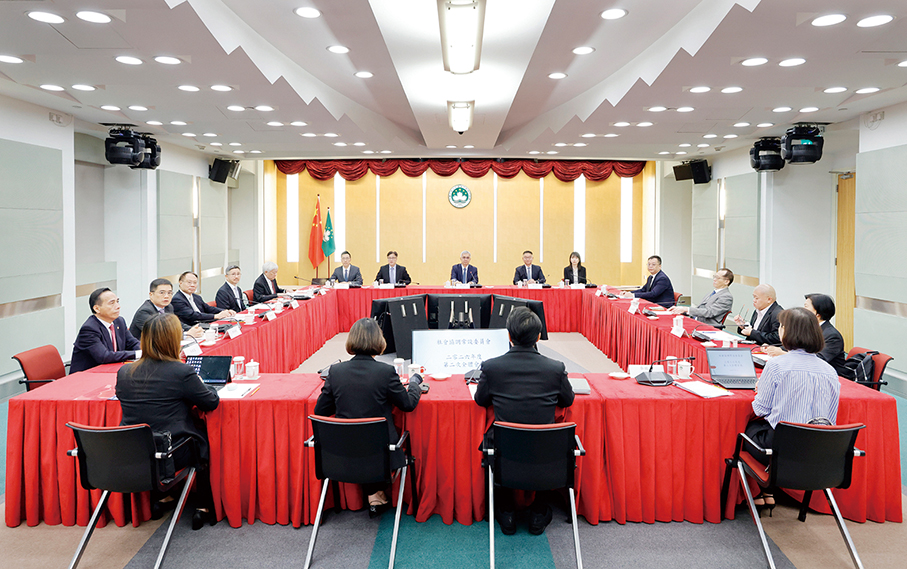
Secretary for Administration and Justice Wong Sio Chak (centre) chairs yesterday’s closed-door meeting of the Standing Council on Social Concerted Action at Government Headquarters. – Photo: GCS