

To mark Teachers’ Day, the Chinese Educators’ Association of Macau (EDUM) hosted the 2026 Teachers’ Day Celebration Assembly yesterday at Macau Fisherman’s Wharf.
In her speech, Secretary for Social Affairs and Culture Wallis O Lam expressed hope that teachers will cultivate more individuals of high virtue and outstanding talent.
Also in attendance were Chief Executive Sam Hou Fai, Zheng Xincong, director of the Liaison Office of the Central People’s Government in the Macau Special Administrative Region (MSAR), Bian Lixin, commissioner of the Ministry of Foreign Affairs of China in the Macao SAR, and Education and Youth Development Bureau (DSEDJ) Director Kong Chi Meng.
In her address, O Lam extended festive greetings to all educators across Macau. She noted that Macau’s higher education international rankings have steadily climbed, the Macao-Hengqin International Education (University) Town is now operational, schools are continually introducing AI to enhance teaching, and patriotic education remains central to the entire educational process. She emphasised that the local government will continue to increase investment in educational resources, promote the development of AI education, refine the teacher training framework, and foster a culture of respect for educators. She encouraged teachers to champion the “educator spirit”, embrace the AI wave, advance the integration of industry and education, and nurture a new generation equipped with both moral integrity and practical ability.
Cheng Hong Kong, president of the Chinese Education Association of Macau (EDUM), extended festive greetings to all educators in Macau during the assembly. He highlighted that in PISA 2025, Macau ranked third globally in science and mathematics literacy, fifth in reading, and first in problem-solving using computational tools – achievements resulting from long-term support from the nation and the local government, alongside the dedicated efforts of local teachers and students. He said that his association will align with government policies and address issues such as low birth rates, national security, patriotic education, and teachers’ rights. He stressed that the association will guide youth to love both the motherland and Macau through seminars, quizzes, and competitions, ensuring patriotic values are passed down through generations.
Ma Iao Fong, president of EDUM’s Youth Branch, described Macau’s PISA 2025 achievements – third globally in science and maths, and top for computational problem-solving – as an encouraging triumph of collaborative efforts between schools, teachers, and students. He noted that achieving educational equity is an ongoing journey that requires continuous refinement of the learning environment, with a particular focus on disadvantaged and diverse families through measures such as after-school care. Facing the AI and digital transformation, he called for stronger STEM (Science, Technology, Engineering, and Mathematics) training for teachers and more practical workshops to help apply new technology in the classroom.
Lei Chao Lam, the principal of Pui Va Middle School remarked that the PISA results validate Macau’s long-term educational commitment. Lei introduced STEM education over a decade ago and equipped every teacher with a tablet, leveraging IT across disciplines combined with formative and diverse assessment to boost autonomous learning. He emphasised a student-centred philosophy where no student is left behind, with teachers providing lesson preparations, counselling, and tailored support so every learner can excel. Amid digital teaching, the school prioritises moral education alongside capabilities, using form-level and well-being teams to support teachers and students alike.
Wang Fan, the director of school curriculum development at Pui Va Middle School, noted that Macau’s PISA success reflects the collective dedication of Macau educators and the strengths of the educational system under “One Country, Two Systems”. To adapt to shifting teaching paradigms, the school champions Project-Based Learning units that integrate multiple subjects, enabling students to solve problems through active learning. Adapting to these new methods requires extensive teacher training. The school also caters to diverse student needs through differentiated instruction, gamification, and tiered assignments, allowing learners to experience steady progress towards significant success. Looking ahead, teachers must understand technology trends, clarify AI application pathways across pre-class, in-class, and post-class stages, and undertake subject-specific AI training, Wang said.
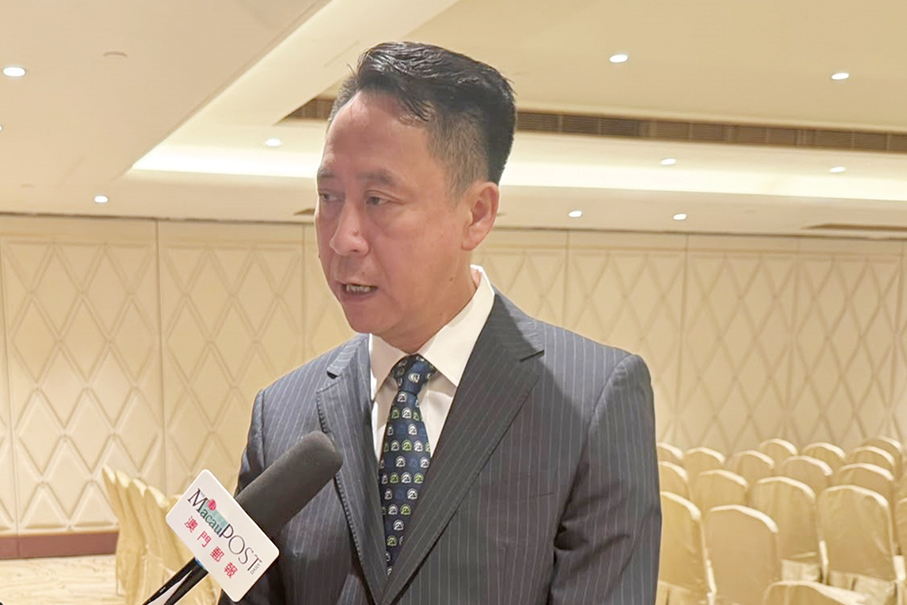
Pui Va Middle School Principal Lei Chao Lam speaks to the Post on the sidelines of yesterday’s event at Fisherman’s Wharf yesterday. – Photo courtesy of Pui Va Middle School
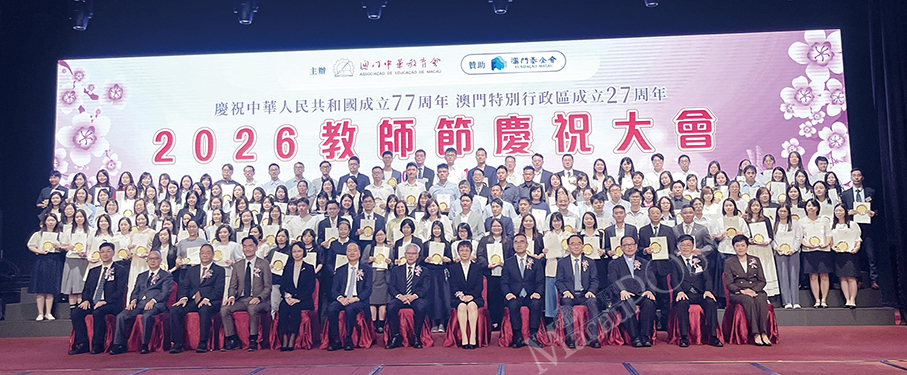
Chief Executive Sam Hou Fai (front row, centre), Zheng Xincong, director of the Liaison Office of the Central People’s Government in the Macau Special Administrative Region (front row, sixth from left), Bian Lixin, commissioner of the Ministry of Foreign Affairs of China in the Macao SAR (front row, sixth from right) and other representatives pose with award-winning teachers. – Photo: Armindo Neves