

The government has completed setting up a new platform powered by AI for members of the public to raise enquiries, complaints, and opinions about all government services. The new platform, available on the Macao One Account app, will start operating next Monday.
The Macao One Account app is available in Chinese, Portuguese, and English.
Commonly seen enquiries will be handled by AI chatbots providing standardised answers, while more complex enquiries will be directed to human customer services, where civil servants will handle and assess the enquiries before giving the answers.
The Public Administration and Civil Service Bureau (SAFP) – the public entity tasked with developing e-government services – held a press conference yesterday to announce details of the new platform.
The government announced in July the establishment of a new system standardising the practices for all public entities to handle and reply to enquiries, complaints, and opinions from members of the public. The system will be governed by a new administrative regulation, which was announced in July and will take effect on Monday next week.
Government-drafted administrative regulations, aka by-laws, do not require the legislature’s approval.
The bureau noted yesterday that, in line with the implementation of the new administrative regulation, the current function on the Macao One Account app for the public to raise enquiries, complaints, and opinions will be upgraded to a new one powered by AI.
In addition to the Macao One Account for members of the general public, upgrades will also be made to the Business and Association Platform app – a dedicated e-government platform for businesses and associations.
Addressing yesterday’s press conference, SAFP Director Leong Weng In said that reforming its public feedback handling mechanism represents an important step for the local government in promoting governance modernisation. The government has advanced the reform based on four core principles – standardised norms, transparent procedures, defined timeframes, and clearly assigned responsibilities, she said, adding that through the integration of system establishment, technical application, and service upgrades, the reform aims to build a public feedback handling mechanism with standardised criteria, traceable procedures, and interdepartmental collaboration.
Public entities must reply within 15 working days
Leong noted that according to the new administrative regulation coming into force on Monday next week, the respective public entities must make their first, basic reply within two working days after receiving enquirers’ opinions or complaints, after which they must, in general, conclude handling each case and come up with a final, complete reply within 15 working days, except when confronted with special circumstances.
Leong noted that according to the regulation, if a case’s particular situation makes it impossible for the respective public entity to complete handling the case and make a final, complete reply within 15 working days, the public entity must, in advance of the 15-working-day deadline, tell the resident that it will not be able to make the final reply within the required timeframe, and provide the resident with information about its latest progress on the case.
Leong said that compared to the current system still in force with a required timeframe of 45 days, the new system will ensure a more timely, clear, and transparent response to the public.
How to use it
During yesterday’s press conference, Chan Chon In, who heads the bureau’s Government Service Information Centre, gave a presentation on how to use the new platform.
Chan said that the new platform has four features: smartphone users can make enquiries 24/7; they can check the latest progress on their case at any time; any case submitted to the platform will be assigned to the respective public entity; and all cases will be handled within a specific timeframe.
Chan said that after the new platform starts operating next Monday, smartphone users will be required to update their Macao One Account app in order to use the new function.
Smartphone users will have to submit their enquiries in text format on the platform. Chan noted that they can use their smartphone’s function to convert their voice into text.
Chan underlined that the new platform integrates AI technology and an interdepartmental collaboration mechanism to establish a new service model featuring immediate response, precise assignment to the respective public entity, and end-to-end tracking.
For commonly seen enquiries regarding service formalities (such as application eligibility, required documents, and service locations), the system will – thanks to the applications of AI – instantly provide accurate and standardised answers alongside various details, including website links, forms, and application guidelines, significantly improving processing efficiency, Chan said.
Chan said that more complex enquiries will be forwarded to human customer services, where civil servants will handle and assess the enquiries before giving the answers in text format on the platform.
The AI-generated answers will be available 24/7, while human customer services will be available during office hours between 9:00 a.m. and 6:00 p.m. from Mondays to Fridays.
Enquiries requiring human customer services submitted during non-office hours will be stored on the system and handled by civil servants during office hours.
Regarding the submission of complaints or opinions, Chan said, the new platform will automatically transfer cases to the respective public entities, so members of the public will no longer need to determine which entity to contact.
Chan noted that all cases will be processed through a uniform e-platform equipped with AI to assist civil servants in swiftly sorting through opinions and complaints and identifying key issues, thereby boosting enquiry and processing efficiency.
A specific public entity will be assigned as the main entity tasked with handling the case, while other relevant public entities will be assigned roles to provide support and cooperation, ensuring coordination and follow-up throughout the entire procedure, Chan said.
Chan underlined that all existing enquiry and feedback channels for the public, such as telephone hotlines and staffed counters, will remain operational, adding that the new platform aims to provide a more convenient and flexible alternative channel alongside these traditional channels.
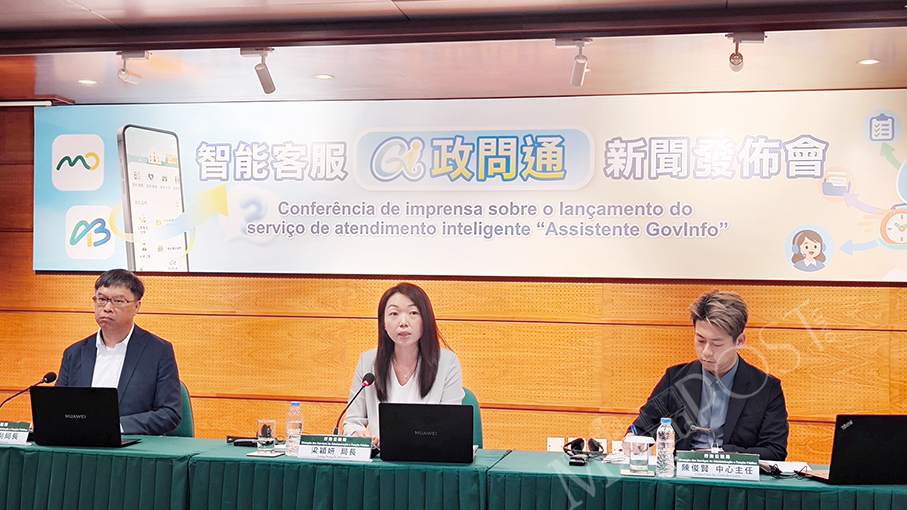
Public Administration and Civil Service Bureau (SAFP) Director Leong Weng In (centre) speaks during yesterday’s press conference at the Public Administration Building on Rua do Campo as SAFP Deputy Director Chan Chi Kin (left) and Chan Chon In, who heads the bureau’s Government Service Information Centre, look on. – Photo: Tony Wong