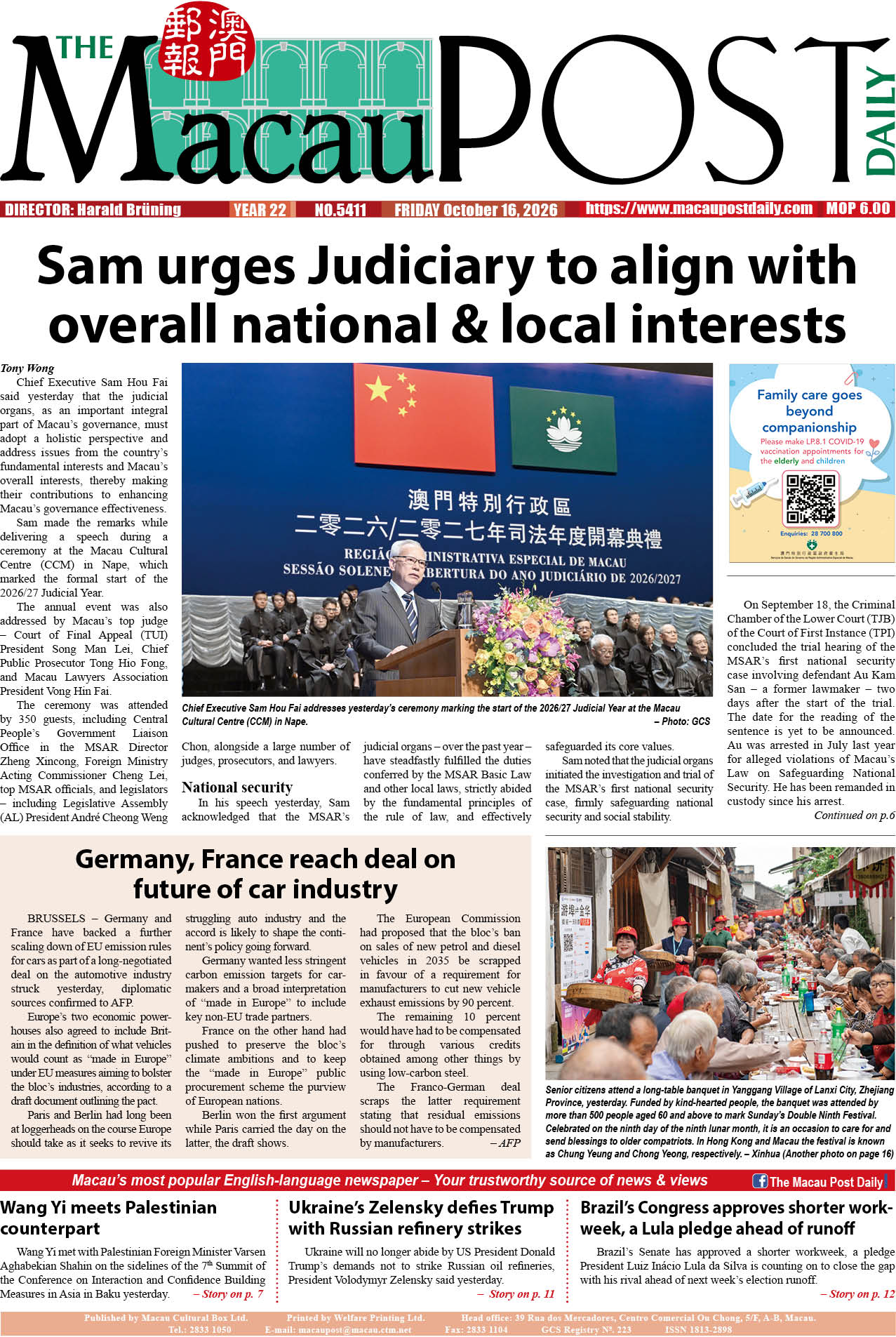


Chief Executive Sam Hou Fai said yesterday that the judicial organs, as an important integral part of Macau’s governance, must adopt a holistic perspective and address issues from the country’s fundamental interests and Macau’s overall interests, thereby making their contributions to enhancing Macau’s governance effectiveness.
Sam made the remarks while delivering a speech during a ceremony at the Macau Cultural Centre (CCM) in Nape, which marked the formal start of the 2026/27 Judicial Year.
The annual event was also addressed by Macau’s top judge – Court of Final Appeal (TUI) President Song Man Lei, Chief Public Prosecutor Tong Hio Fong, and Macau Lawyers Association President Vong Hin Fai.
The ceremony was attended by 350 guests, including Central People’s Government Liaison Office in the MSAR Director Zheng Xincong, Foreign Ministry Acting Commissioner Cheng Lei, top MSAR officials, and legislators – including Legislative Assembly (AL) President André Cheong Weng Chon, alongside a large number of judges, prosecutors, and lawyers.
National security
In his speech yesterday, Sam acknowledged that the MSAR’s judicial organs – over the past year – have steadfastly fulfilled the duties conferred by the MSAR Basic Law and other local laws, strictly abided by the fundamental principles of the rule of law, and effectively safeguarded its core values.
Sam noted that the judicial organs initiated the investigation and trial of the MSAR’s first national security case, firmly safeguarding national security and social stability.
On September 18, the Criminal Chamber of the Lower Court (TJB) of the Court of First Instance (TPI) concluded the trial hearing of the MSAR’s first national security case involving defendant Au Kam San – a former lawmaker – two days after the start of the trial. The date for the reading of the sentence is yet to be announced. Au was arrested in July last year for alleged violations of Macau’s Law on Safeguarding National Security. He has been remanded in custody since his arrest.
Mid-term review
Sam, who took office as the MSAR’s sixth-term and fourth Chief Executive on December 20, 2024, said in his speech yesterday that next year will mark the mid-term review of the current government’s performance, bringing tight deadlines, heavy tasks, and high standards across all areas of governance. Concurrently, Sam said, Macau’s internal and external environments are undergoing profound and complex changes, requiring the MSAR’s organs of political power and governance to maintain high risk awareness, crisis alertness, and a bottom-line mindset at all times.
The MSAR’s three organs of political power and governance consist of executive, legislative, and judicial organs.
The MSAR’s judicial organs comprise the Public Prosecutions Office (MP) and the courts, which consist of the Court of First Instance (TPI), the Court of Second Instance (TSI), and the Court of Final Appeal (TUI).
In addition, Sam underlined the need to accurately identify issues, formulate scientific responses, and proactively seek solutions, so as to better overcome various internal and external risks and challenges, with the aim of building a sustainably developed, more dynamic, and more competitive Macau that better ensures the well-being of its residents.
Sam said that in the face of new opportunities and challenges, the judicial organs, as an important integral part of Macau’s governance, must adopt a holistic perspective, address issues from the country’s fundamental interests and Macau’s overall interests, and jointly uphold and improve Macau’s executive-led system, thereby contributing to enhancing Macau’s governance effectiveness.
Sam raises 7 requirements for Judiciary
To this end, Sam raised seven requirements for Macau’s judicial organs in his speech.
First, Sam said, the judicial organs should firmly uphold the MSAR’s constitutional order established by the nation’s Constitution and the MSAR Basic Law.
Sam underlined the need for the judicial organs to strictly fulfil the duties and functions conferred by the Constitution and the Basic Law, exercise judicial power and prosecutorial functions independently and in accordance with the law, create a fair, efficient, and predictable judicial environment, resolutely safeguard the sound order of the rule of law in Macau, and better meet the public’s expectations regarding fairness and justice.
Second, Sam said, the judicial organs should enhance awareness of anti-corruption prevention and enforcement, firmly establishing the bottom lines and red lines of integrity and impartiality.
Sam said that the Judiciary is the last line of defence for social justice and fairness, and judicial integrity is the prerequisite and foundation of judicial justice; any behaviour that harms the image of the Judiciary will undermine civil society’s confidence in the rule of law, Sam said.
Sam noted that judicial personnl must be honest and impartial, and strengthen their ability to prevent and combat corruption so as to earn the trust of society and the public, allowing the parties involved to truly feel the fairness and justice of the legal and judicial system. He urged judicial personnel to uphold the dignity of the rule of law with a stronger sense of responsibility.
Third, Sam said, the judicial organs should optimise personnel management and accelerate the formation of a more professional and efficient judicial team.
Sam noted that since Macau’s return to the motherland, the number of judicial personnel has expanded. From the time shortly after the establishment of the MSAR, the number of judges across the three levels of courts has increased from 23 to 50, while the number of prosecutors has increased from 20 to 40. The total number of other judicial officers at the assistant level across the three levels of courts and the Public Prosecutions Office has increased from 146 to 390 during this period.
Sam said that judicial statistics over the past decade show that the issue of “many cases and few staff” has undergone a substantial change. Macau’s socioeconomic development in this new phase will inevitably place new and higher demands on judicial work, Sam said, urging the judicial organs to strengthen their administrative management, intensify personnel training, improve staff professionalism and competencies, and fully utilise existing human resources to meet the needs arising from socioeconomic development with high-quality judicial services.
Fourth, Sam said, the judicial organs should continue to improve the judicial system and effectively enhance judicial efficiency.
Sam underlined the need for the judicial organs to conduct studies on new systems and mechanisms, innovate with courage, draw on successful experiences from the Chinese mainland and other countries and regions, keep pace with the trends and demands of the new era, explore e-justice according to Macau’s situation, and introduce and enhance the application of new technologies – such as AI – in stages like case management and document drafting.
Fifth, Sam said, the judicial organs should serve the mission of Macau’s development through judicial work.
Sam underlined the need for the judicial organs to handle all illegal and criminal acts that endanger national security and the MSAR’s public security in accordance with the law, ensuring Macau’s stability and providing an environment conducive to development.
Through adjudication, the judicial organs should strengthen the protection of the legitimate rights and interests of market entities of all types, improve Macau’s business environment, and make greater contributions to Macau’s appropriate economic diversification, he said.
Sam also underlined the need for Macau’s judicial organs to step up exploration and innovation regarding rule alignment and mechanism integration at the judicial level in the development of the Guangdong-Macao In-Depth Cooperation Zone in Hengqin.
Sixth, Sam said, the judicial organs should vigorously participate in the construction of the rule of law in Macau by leveraging their expertise and practical experience.
Sam underlined that the local government is steadily advancing the drafting of improvements to Macau’s major laws, including five major codes. He said he expects judicial personnel to leverage their expertise and rich practical experience to provide more professional and intellectual support for drafting new legislation and amendments to existing legislation, with the aim of jointly building a modern legal system more closely aligned with the needs of Macau’s socioeconomic development.
Seventh, Sam urged the judicial organs to strengthen judicial exchange and cooperation at regional and international levels, leveraging Macau’s unique status and advantages as a bridge between the Chinese mainland and the rest of the world, as well as its role as a bridge in cross-jurisdictional collaboration, expanding external judicial cooperation networks and enhancing judicial and law enforcement efficiency in cases involving foreign countries.
Meanwhile, in his speech, Sam also urged the Macau Lawyers Association to accelerate institutional reform and strengthen sector governance, promoting greater standardisation and modernisation in the legal profession. He also called for the association to study amendments to the Statute of Lawyers so as to remove bottlenecks hindering the sector’s development.
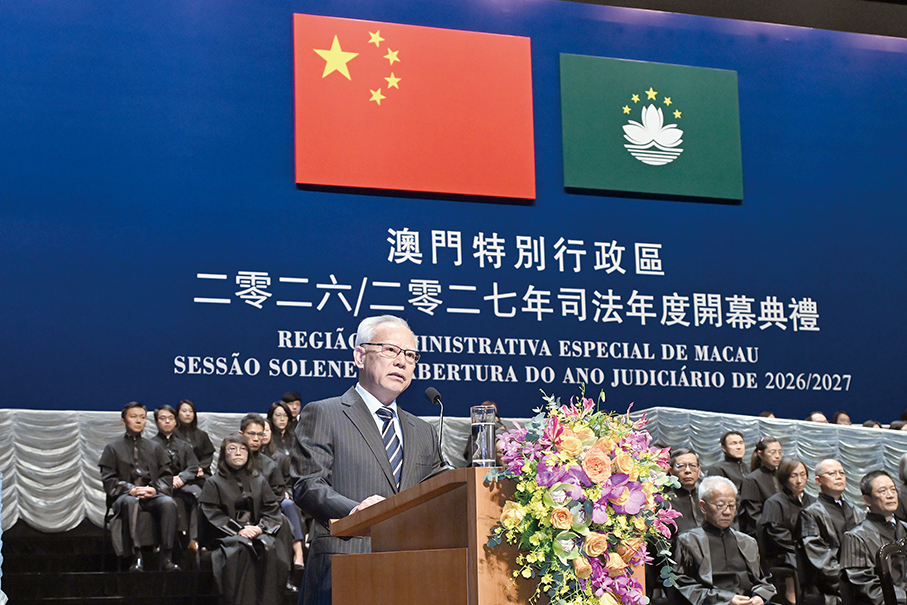
Chief Executive Sam Hou Fai addresses yesterday’s ceremony marking the start of the 2026/27 Judicial Year at the Macau Cultural Centre (CCM) in Nape. – Photo: GCS
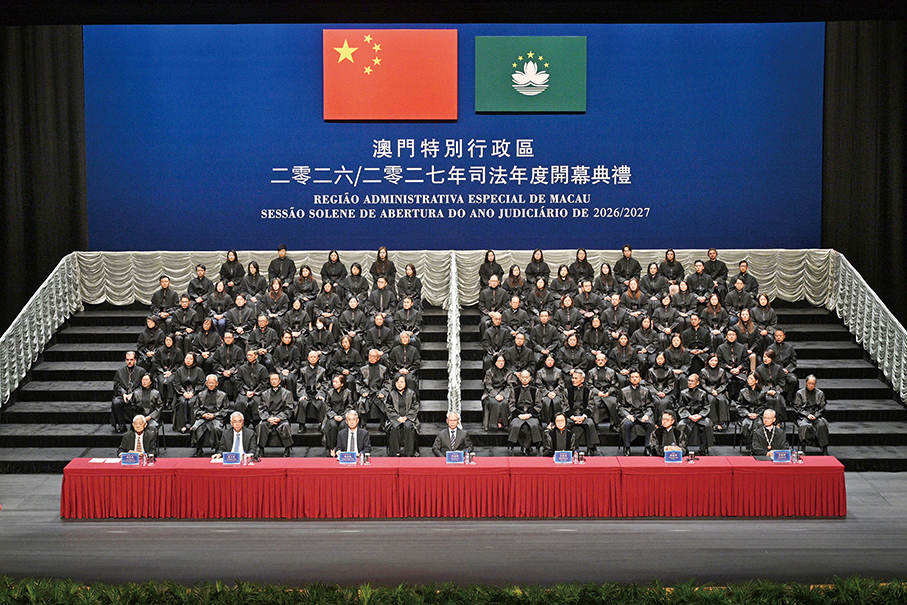
Chief Executive Sam Hou Fai (front, centre), Macau’s top judge Song Man Lei (front, third from right), chief public prosecutor Tong Hio Fong (front, second from right), Macau Lawyers Association President Vong Hin Fai (front, right), Legislative Assembly President André Cheong Weng Chon (front, third from left), as well as judges and prosecutors attend yesterday’s ceremony marking the formal start of the 2026/27 Judicial Year. – Photo: GCS