

Considering that the central authorities’ 15th Five-Year Plan and Macau’s Third Five-Year Plan are getting off the ground at a gallop in the run-up to the Year of the Horse, it is the right moment to reflect on the importance of making sure that the national plan and the two regional plans – Hong Kong has finally come up with its 1st Five-Year Plan – are aligned with each other.
I am convinced that national alignment is the key to success for the two regional plans. This editorial is focused on the alignment between the plans designed by the central authorities and those in the Macau Special Administrative Region (MSAR).
In economics, alignment offers a raft of benefits such as maximising limited financial and human resources and raising the effectiveness of investments by reducing duplication. Alignment refers to the synchronisation of economic activities, policies, and structures to achieve certain goals, such as sustainability, strategic business objectives and, increasingly, AI issues. Within this ambit, President Xi Jinping has introduced and promoted the concept of “new quality productive forces” as a core strategy to drive high-quality economic development, moving away from traditional, resource-intensive growth towards innovation-driven growth. First mentioned in 2023, this concept emphasises technological breakthroughs, high efficiency, and high quality.
The national 15th Five-Year Plan and the MSAR’s 3rd Five-Year Plan run from this year through 2030. The foundational recommendations for the national plan were adopted at the 4th Plenary Session of the 20th Central Committee of the Communist Party of China (CPC) last October. The final version of the 15th Five-Year Plan is slated to be reviewed and approved by the National People’s Congress (NPC) in Beijing next month during the annual “Two Sessions”, i.e., the session of the NPC and concurrent one of the advisory Chinese People’s Political Consultative Conference (CPPCC).
According to observers, the national 2026-2030 plan will prioritise high-quality development, technological self-reliance, and green transformation as the country navigates increasing global uncertainties. President Xi’s imprint on the plan is obvious.
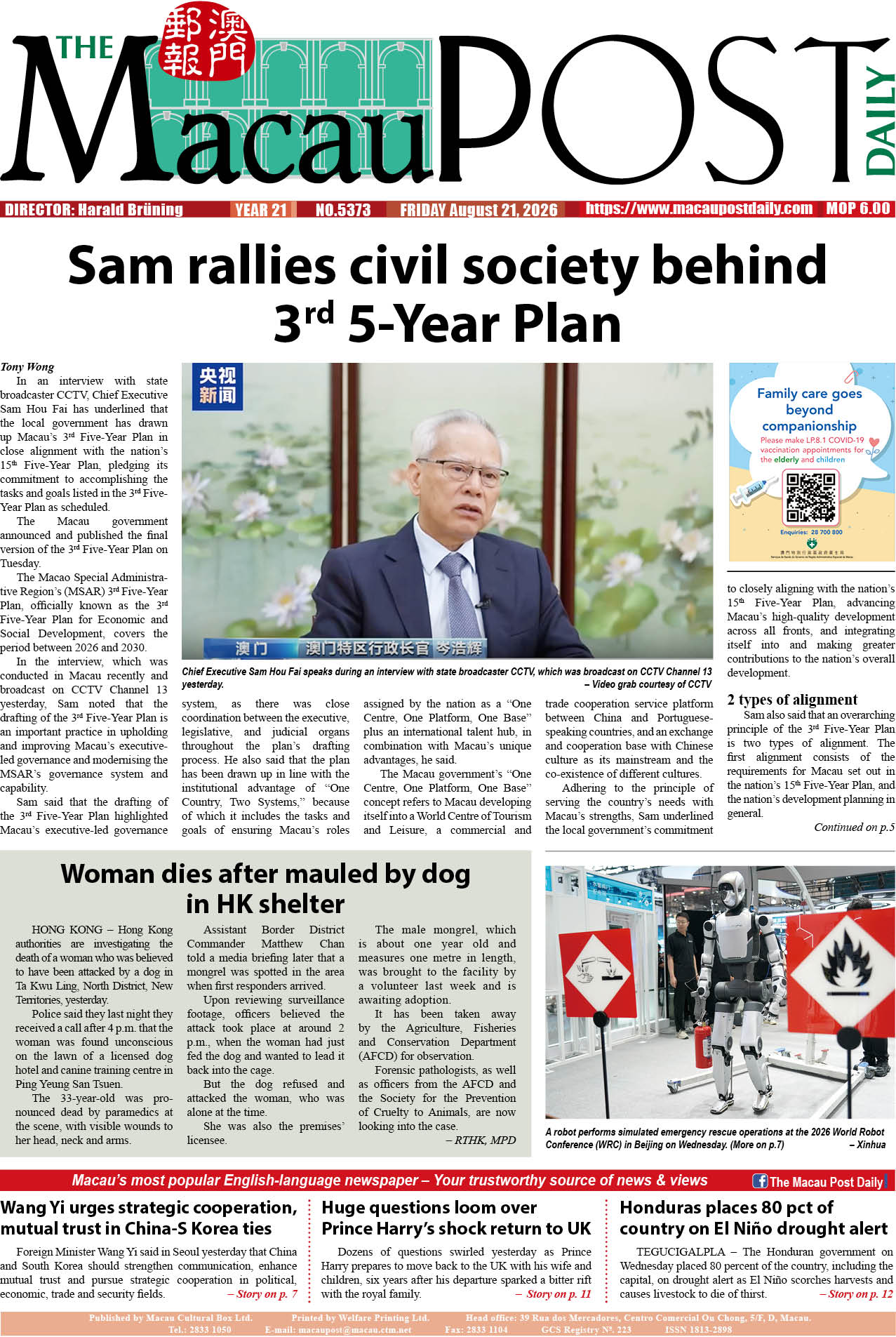
Chief Executive Sam Hou Fai stated earlier this month that the local government is advancing the formulation of Macau’s 3rd Five-Year Plan, noting that it will be based on scientific evaluation and public consultation.
Evidently, the local plan prioritises Macau’s “1+4” appropriate economic diversification strategy, national security, public administration reform, and the development of the Guangdong-Macao In-Depth Cooperation Zone in Hengqin.
“1+4” aims to consolidate Macau’s position as a “World Centre of Tourism and Leisure” and to prioritise the growth of four emerging industries, namely Big Health (including TCM); modern financial services, such as developing a bond market and FinTech; High Tech and innovation, namely scientific research and developing the digital economy; and strengthening Macau’s position as a hub for international conventions, culture, and sport.
The 15th Five-Year Plan marks a significant shift in how Hong Kong and Macau are to integrate with the Chinese mainland through their proactive involvement in the further development of the Guangdong-Hong Kong-Macao Greater Bay Area (GBA), as a crucial engine for high-quality development, focusing, among other things, on advanced manufacturing and sci-tech innovation, as well as “soft connectivity”, i.e., the aim of boosting non-physical or intangible connections that enable communication, collaboration, and interaction among people, organisations, or systems. The ultimate objective is to strengthen ties between the 11-member GBA’s nine Guangdong cities and the nation’s two special administrative regions (SARs) – Hong Kong and Macau.
I am quite optimistic that the GBA will be the world’s most successful “bay area” economy long before the People’s Republic of China (PRC) celebrates the 100th Anniversary of its founding by the CPC on October 1, 2049.
The GBA covers a land area of around 56,000 square kilometres (the size of Togo in West Africa) and a population of over 87 million (the size of Turkey), accounting for 31 percent of the land area of Guangdong Province.
Within a mere seven years after its official launch in February 2019, the GBA has grown into a global power house of manufacturing and research. Where else would something like that be possible? Perhaps, if at all, on another planet…
Macau is the smallest of the 11 members of the GBA, covering just 0.06 percent of its land area and 0.8 percent of its population – but 2.4 percent of its GDP last year (417 billion patacas/US$52 billion of the GBA’s 15 trillion yuan/US$2.15 trillion GDP).
Well, small is beautiful and, as we Macau residents know, our 33.3 km2 “city-village” (as a decades-long resident here, I am convinced that Macau’s peculiar charm – being the nation’s celebrated “pearl on the palm” – consists of its duality of being an international city and a “very local” village simultaneously). Besides, Macau has been punching well above its weight for centuries – as a centre of Orient-Occident cultural exchange and learning, a commercial entrepôt, erstwhile a renowned manufacturing base of pyrotechnics (Macau firecrackers were globally sought after in the not so distant past), and a platform for commercial and cultural ties between China and the nine-nation Portuguese-speaking world; the 10 countries together representing about one-fifth of the world population).
The 15th Five-Year Plan focuses on Macau’s further development based on the “One Centre, One Platform, One Base” strategy, with a push that is loud and clear for the “appropriate” diversification of its economy which continues to be overly dependent on its world-famous gaming industry.
I hope that Macau’s gaming industry will further strengthen investment in non-gaming aspects of the ludic industry, such as concerts and other artistic and cultural events, conventional and e-sports, ideally involving educational aspects such as teaching and learning through play – well, that’s what the Latin adjective “ludic” relates to. In ancient Rome, “ludic” referred not only to games, play and sport but also to educational activities, such as establishments where children were taught through play.
Of course, all this must always be based on economic reality – it would be imprudent to kill the proverbial goose that lays the golden egg. Government-concessioned gaming businesses have been part of Macau’s economic fabric since 1849. Indeed, the sector is a major element of Macau’s cultural heritage. After all, culture is a significant part of the economy, in the case of Macau in particular, considering that our UNESCO World Heritage status is one of our best-known tourist attractions – just (try) to visit the area around St Paul’s Ruins and Na Tcha Temple, not just at a weekend. The tight crowds belie the claim that “almost all” tourists are “only” interested in Macau’s entertainment industry.
At last week’s Spring Festival reception hosted by the Liaison Office of the Central People’s Government in the MSAR, both Liaison Office Director Zheng Xincong and Chief Executive Sam Hou Fai highlighted in their respective speeches the commitment to proactively align Macau’s development drive with the national 15th Five-Year Plan, based on the requirements raised by President Xi during his annual duty meeting with Sam in Beijing in late December.
Zheng singled out Xi’s requirement to further improve its executive-led governance, solidly advance Macau’s appropriate economic diversification, continuously enhance its governance effectiveness, and better integrate and service the nation’s overall development
Sam pledged in his speech that the local government will use its 3rd Five-Year Plan as a key lever, proactively aligning it with the central authorities’ 15th Five-Year Plan. Sam reaffirmed that 2026 will be pivotal year for aligning the MSAR with national strategies, “seizing opportunities and continuously advancing reform”.
Deepening integration with the GBA in general, and with the Guangdong-Macao In-Depth Cooperation Zone in Hengqin in particular, will, undoubtedly, be the main focus of Macau’s 3rd Five-Year Plan, apart from the local authorities’ determination of strengthening national security and developing Macau into a “smarter” and more liveable and sustainable city – which includes ongoing efforts to tackle our city’s public transport and traffic woes, a predicament that affects both locals and visitors and is tarnishing our standing as a World Centre of Tourism and Leisure.
In my view, public transport is one of the most pressing challenges that Macau needs to tackle head on during the 3rd Five-Year Plan. Local officials should ask their counterparts in the Chinese mainland for advice and assistance. Each time I am visiting the Chinese mainland, the GBA specifically, I am stunned by the effectiveness of public transport there.
I must admit that the transport and traffic situation – our bendy roads and narrow lanes have to cope with over 250,000 motor vehicles – in Macau is complex and somewhat contradictory, and this sound almost like the understatement of the year. This reminds me of Mao Zedong’s insistence that all problems can readily be solved by grasping the contradictions that cause them, in his essay “On Contradiction,” written in August 1937.
Macau has the financial wherewithal to take on its development challenges. Among international credit agencies, the MSAR is known for its robust fiscal buffers and financial resilience. Its fiscal reserves amounted to 661 billion patacas (that’s an astonishing US$82.6 billion last November – or more than 0.6 trillion patacas), while its forex reserves amounted to 240.8 billion patacas – that’s money, indeed!
On the public finance front, Macau’s is, indubitably, the envy of the world. But I also believe that for financial reserves to be useful, a financially safe portion of them should be used to solve practical problems.
Based on the “One Country, Two Systems” principle, which is the constitutional cornerstone of the existence of the MSAR, Macau’s 3rd Five-Year Plan’s alignment with the central authorities’ 15th Five-Year is both reasonable and sensible. To put it more plainly: it makes sense.
Macau is not only an autonomous region of the PRC, but also an inalienable part of it, as clearly stated by Articles 1 and 2 of the Basic Law of the MSAR of the PRC. That’s why the alignment between the two plans is constitutionally valid. On top of that, “One Country” precedes “Two Systems”.
For Macau to be able to maintain and even further grow its high standard of living (one of the world’s highest), integration with the GBA is not only a fundamental requirement but also a desideratum. While Macau recorded a daily average of nearly 110,000 visitor arrivals last year, tens of thousands of Macau residents travel every day to Zhuhai and beyond in the GBA for shopping, eating-out, having their hair and nails done, or just for R&R.
Macau, Hong Kong and the Guangdong section of the GBA are quickly growing together into one of the world’s top metropolises. That’s an exciting development. I welcome it wholeheartedly.
I am sure that Macau’s one-of-a-kind socio-cultural identity is vigorous enough to continue to play a meaningful role in the GBA. So let’s go full steam ahead with the alignment concept, without which Macau’s quinquennial plan would not be able to succeed, bearing in mind that its ever closer cooperation with the Chinese mainland is nowadays a matter of course.
– Harald Brüning