

The government has added 28 more items to its inventory of intangible cultural heritage, one of which is Preparation of Pork Chop Buns, according to a notice published by the Cultural Affairs Bureau (IC) in the Official Gazette (BO) yesterday.
After adding the 28 items, the inventory now has 98 items of Macau’s intangible cultural heritage.
The Cultural Heritage Protection Law defines cultural heritage as comprising intangible cultural heritage and tangible cultural heritage that consists of classified immovable properties, i.e., cultural heritage construction structures, and movable properties.
According to the law, which came into force in March 2014, the Cultural Affairs Bureau is required to draw up an inventory of intangible cultural heritage with the aim of ensuring the protection of Macau’s various items of intangible cultural heritage. The bureau is also required to update the inventory, i.e., adding items, in compliance with the findings of its latest surveys and research studies.
According to its themed website on Macau’s cultural heritage, the bureau first put 15 items of intangible cultural heritage into the inventory in 2017, before adding 55 more in 2020, raising the number of items to 70. Following the inclusion of the 28 additional items published yesterday, the inventory now comprises 98 items.
Preparation of Pork Chop Buns is one of the 28 newly added intangible cultural heritage items. In Cantonese, a pork chop bun is called 豬扒包 (“jyu pa baau”).
In addition to its notice published in the gazette, the bureau also issued a statement yesterday on the matter. The bureau has also updated its themed website on cultural heritage, adding details on the 28 new items, but only available in Chinese. Details on the first 70 items are available Chinese, Portuguese and English.
28 items
According to yesterday’s announcements, the 28 new items comprise 1) Macanese Songs, 2) Guangdong Classical Music, 3) Nanyin Music of the Minnan Community, 4) Fishermen’s Knowledge and Practices Related to Nature and the Universe, 5) Hung Martial Arts, 6) Pak Mei Martial Arts, 7) Orthopaedics (Tit Ta), 8) Acupuncture and Moxibustion, 9) All Souls’ Day, 10) Devotion and Procession of Our Lady of Remedies, 11) Macanese Fat Tea, 12) Meal Customs of Yum Cha, 13) Belief and Customs of Va To*, 14) Festival of the Myanmar-Chinese Water Splashing, 15) Preparation of Siu Mei Barbecue, 16) Preparation of Glutinous Rice Cakes, 17) Preparation of Peanut Candy, 18) Preparation of Traditional Western-Style Pastries, 19) Preparation of Burmese Noodles, 20) Preparation of Indonesia Sweets and Pastries, 21) Preparation of Hakka-Style Steamed Glutinous Rice Cakes, 22) Preparation of Chaozhou-Style Pancakes, 23) Preparation of Pork Chop Buns, 24) Milk Tea Brewing, 25) Decorative Paper Art of Batê-Saia**, 26) Gold and Silver Jewellery Techniques, 27) Floral Panel Assembly, and 28) Art and Techniques of Making Miniature Wooden Boats.
Pork chop buns’ cultural value
According to the bureau’s themed website on cultural heritage, Macau’s craft of making pork chop buns originated in the mid-20th century in Taipa Village. As an area where Chinese and Portuguese/Macanese communities lived side by side, the district experienced frequent exchanges between Chinese and Western culinary cultures. Local “cha chaan tengs” (traditional Hong Kong and Macau-style cafés) drew upon the production method of Portuguese “relief bread” popular amongst locals, alongside Portuguese spice-marinating techniques. Combining these with Chinese culinary preferences, they experimented with inserting a pork chop into a bread roll, gradually forming a preparation craft with distinct local characteristics.
Currently, according to the website, the craft of making pork chop buns relies primarily on local heritage cha chaan tengs and family transmission via word of mouth and daily practice, with no systematic training mechanism established as yet. Macau currently has over a dozen long-standing establishments serving traditional pork chop buns, with around 50 to 100 practitioners possessing these traditional craft skills. However, traditional methods demand significant manual labour and time, involving complex and physically demanding steps. As senior masters age, the intergenerational transmission of the craft faces pressure, highlighting the need for further protection and preservation measures.
Inventory vs statutory protection list
The items listed in the Cultural Affairs Bureau’s Inventory of Intangible Cultural Heritage indicate their official status as being required to be protected as the first step. In addition, according to the Cultural Heritage Protection Law, the government is also required to decide whether to classify certain intangible cultural heritage items that are already in the inventory as statutorily protected ones, officially known as List of Intangible Cultural Heritage.
According to the law, items listed in the List of Intangible Cultural Heritage indicate that they are of significant cultural value to Macau. Items newly classified in the statutorily protected List of Intangible Cultural Heritage must be published in an executive order signed by the secretary for social affairs and culture in the gazette to take legal effect, demonstrating a higher legal status than items newly listed in the Inventory of Intangible Cultural Heritage, which are merely required to be published in a notice by the Cultural Affairs Bureau in the gazette.
According to the law, the government is required to consult the public about its proposal to list certain intangible cultural heritage items as statutorily protected ones.
Macau currently has 24 items in the statutorily protected List of Intangible Cultural Heritage, comprising 12 items listed in December 2019 and 12 items listed in October last year.
* Va To (華佗, Hua Tuo, c. 140–208 CE) was a legendary physician of the late Eastern Han dynasty. Revered in Chinese history as the pioneer of traditional surgery, the inventor of Mafeisan (an early herbal anaesthetic), and the creator of the Five-Animal Exercises (Wu Qin Xi), Va To was posthumously deified as Va To Sin Si (華佗先師 / Immortal Master Va To) or the “Divine Physician” (Sam Yi / 神醫). – Gemini, MPD
** Batê-Saia (“skirt-pleating” or “skirt-ruffling” in the local Patuá Creole) is a traditional Macanese decorative paper-cutting art native to Macau. It forms an integral part of the territory’s Luso-Asian intangible cultural heritage, bridging European paper-lace traditions with Chinese paper-cutting techniques. – Gemini, MPD
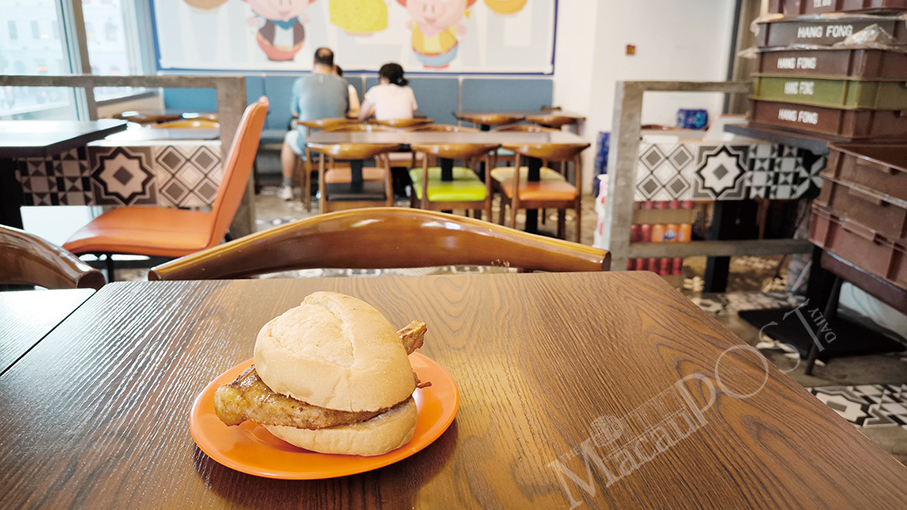
This photo taken yesterday shows a pork chop bun served in the Tai Lei Loi Kei restaurant on Travessa do Roquete, a short alley near Largo do Senado, the city’s main square. Launched in Taipa in 1968, the restaurant, with pork chop bun as one of its top favourites, now has three outlets: two in Taipa Village and one on Travessa do Roquete. – Photo: Tony Wong