

On Friday afternoon, at the local Office of the Commissioner of the Ministry of Foreign Affairs, I had the honour of attending a screening of one of the most emotionally resonant historical films I have ever seen. I must admit I was on the verge of tears several times during the feature-length film – a rare occurrence in my life.
The screening of “The Composer”, held in conjunction with a photo exhibition marking the 80th Anniversary of the Victory in the Chinese People’s War of Resistance Against Japanese Aggression and the World Anti-Fascist War, was hosted by Commissioner Liu Xianfa. It was attended by foreign trade representatives posted to Macau, local journalists, and academics, among others.
The 2019 China-Kazakhstan co-production - the first between the neighbouring countries - depicts the true life story of one of the nation’s greatest composers, Macau-born Xian Xinghai, between 1941 and 1945. In June 1941, at the start of the Soviet Union’s Great Patriotic War against Nazi Germany, Xian was in Moscow composing the score for the documentary film “Yan’an and the Eighth Route Army”. The outbreak of war made it impossible for him to return to his beloved motherland, which was fighting a war of survival against Japanese aggression. He became stranded in Alma-Ata, the capital of the then Kazakh Soviet Socialist Republic (as Soviet film production companies from Leningrad, Kyiv, and Moscow were being relocated there), suffering abject poverty, hunger, sickness and, last but not least, a painful separation from the motherland and his wife and daughter, who had remained at the Communist Party of China’s headquarters in Yan’an.
In Alma-Ata, the Kazakh composer Bakhytzhan Baikadamov befriended Xian, providing him with shelter, inviting him to join the local orchestra, and urging him to continue composing. It was in Alma-Ata (now known as Almaty) that Xian composed the patriotic symphonies “Liberation of the Nation” and “Sacred War”, the orchestral suite “Red All Over the River”, and the “Chinese Rhapsody” for orchestra.
In Alma-Ata, Xian developed pulmonary tuberculosis due to overwork and malnutrition. After the war, he returned to Moscow for medical treatment but died of pulmonary disease on October 30, 1945 at the age of 40.
As Commissioner Liu pointed out in his introduction to the film, Xian is one of the few national figures born in Macau.
Xian was born into a Tanka (boat dweller) family in Macau on June 13, 1905. His father died before he was born. His name in Cantonese transliteration is Sin Sing Hoi. He moved frequently with his mother, growing up in Singapore and Guangzhou. In 1938, he moved to the CPC headquarters in Yan’an, where he became dean of the Music Department at the Lu Xun Institute of Arts. It was there that he composed the stirring, large-scale choral work “Yellow River Cantata”, for which he is best known.
All in all, Xian composed two symphonies, a violin concerto, four large-scale choral works, nearly 300 songs, and an opera.
The film’s overriding themes are Xian’s burning desire to return to his war-torn homeland, his deep friendship with Baikadamov, and his warm but platonic relationship with a Kazakh widow – who, initially only reluctantly, provides him shelter – and her young daughter, who quickly comes to treat him as a real uncle.
Without giving away too much of the plot, I highly recommend this film to anyone interested in Chinese history, as well as that of the former Soviet Union and the present-day Republic of Kazakhstan. The nearest I have ever been to the Central Asian country was its border with China’s Xinjiang Uygur Autonomous Region, which I visited with a local media delegation organised by the Macau-based Foreign Ministry Commissioner’s Office a few years ago. After watching the film, my long-standing desire to visit Kazakhstan has been revived.
Jun Hu, a well-known Beijing-born actor and producer, plays the title role in an impressively poignant way. The performances of the Kazakh actors – actresses Aruzhan Jazilbekova and Dilnaz Nurseit as the widow and her daughter, respectively, and Berik Aitzhanov as Baikadamov –are also stupendous.
Since my university years, I have been an admirer of Soviet and Russian cinematography, namely for its emotional depth and superb camera work. As Vladimir Lenin famously said, “Of all the arts, for us the most important is cinema.”
I believe the film should be shown periodically in all local schools and universities, as well as by community associations. It demonstrates that there are Macau natives who played an important role in their nation’s successful fight against Japanese militarism, and fascism in general. As the film explains, music is an effective way to rally war-weary citizens. Macau’s public broadcaster TDM should also screen the film at regular intervals with Chinese, Portuguese, and English subtitles, as it features dialogue in Chinese, Russian, and Kazakh.
Visual media is particularly powerful in promoting patriotism.
Considering that China this week celebrates the 80th anniversary of its hard-won victory over Japan, the film has regained its topicality. It also shows that while Macau’s Portuguese rulers remained neutral during WWII, virtually all its Chinese residents – and not only them – backed the arduous struggle of the Chinese United Front Against Japanese Aggression. This is what many locals have told me for decades.
So far, Macau has honoured its most famous son in three ways: an avenue has been named after him, a bronze statue has been erected in his honour (both located in Nape), and the Xian Xinghai Memorial Museum opened in November 2019.
Last month, the museum received historical materials related to the composer, such as sheet music, documents, and photos, donated by Baldyrgan Baikadamova, the daughter of Xian’s cherished friend Bakhytzhan. She travelled to Macau to hand the materials to Cultural Affairs Bureau (IC) Vice President Choi Kin Long during a ceremony held at the museum on 23 August.
We should all be grateful for her donation. However, I also think the local authorities could – and should – do more to honour Xian. His memory deserves it, as do all the victims of that awful war.
– Harald Brüning
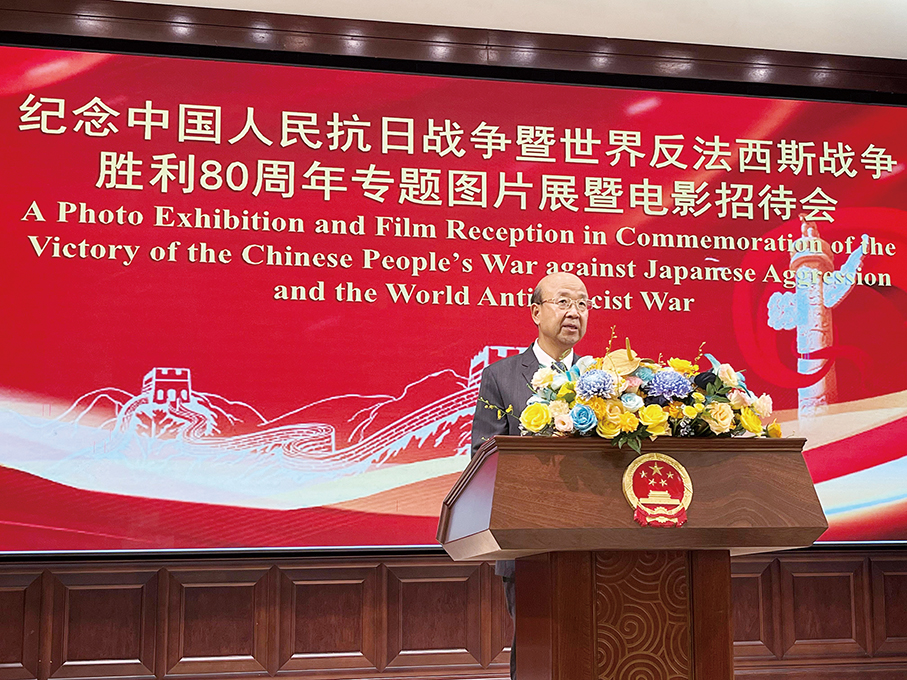
Foreign Ministry Commissioner Liu Xianfa gives a brief introduction to “The Composer” before its screening at the Office of the Commission on Friday afternoon. – Photo: Maria Cheang Ut Meng
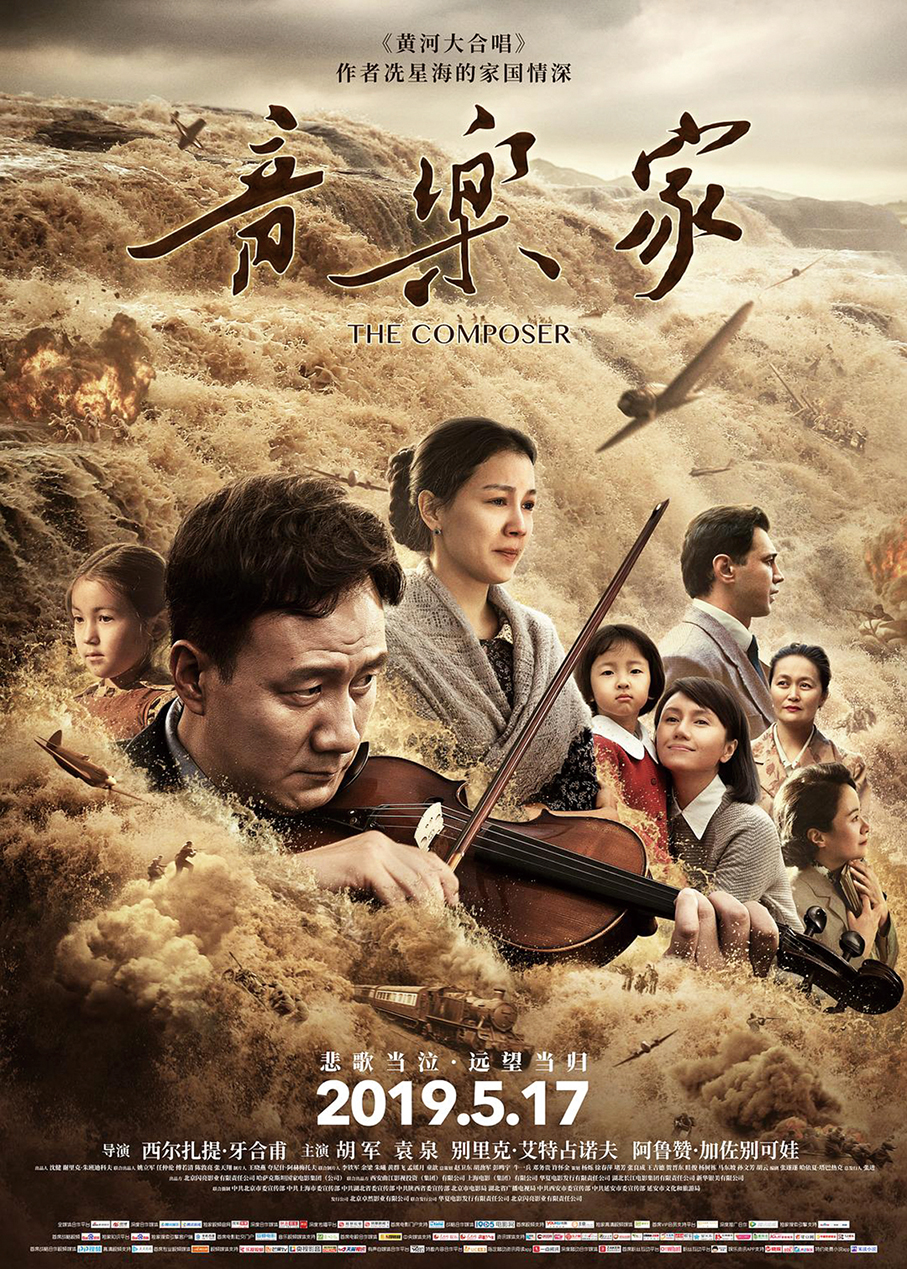
Theatrical release poster for “The Composer” – Image courtesy of Sino-Cinema
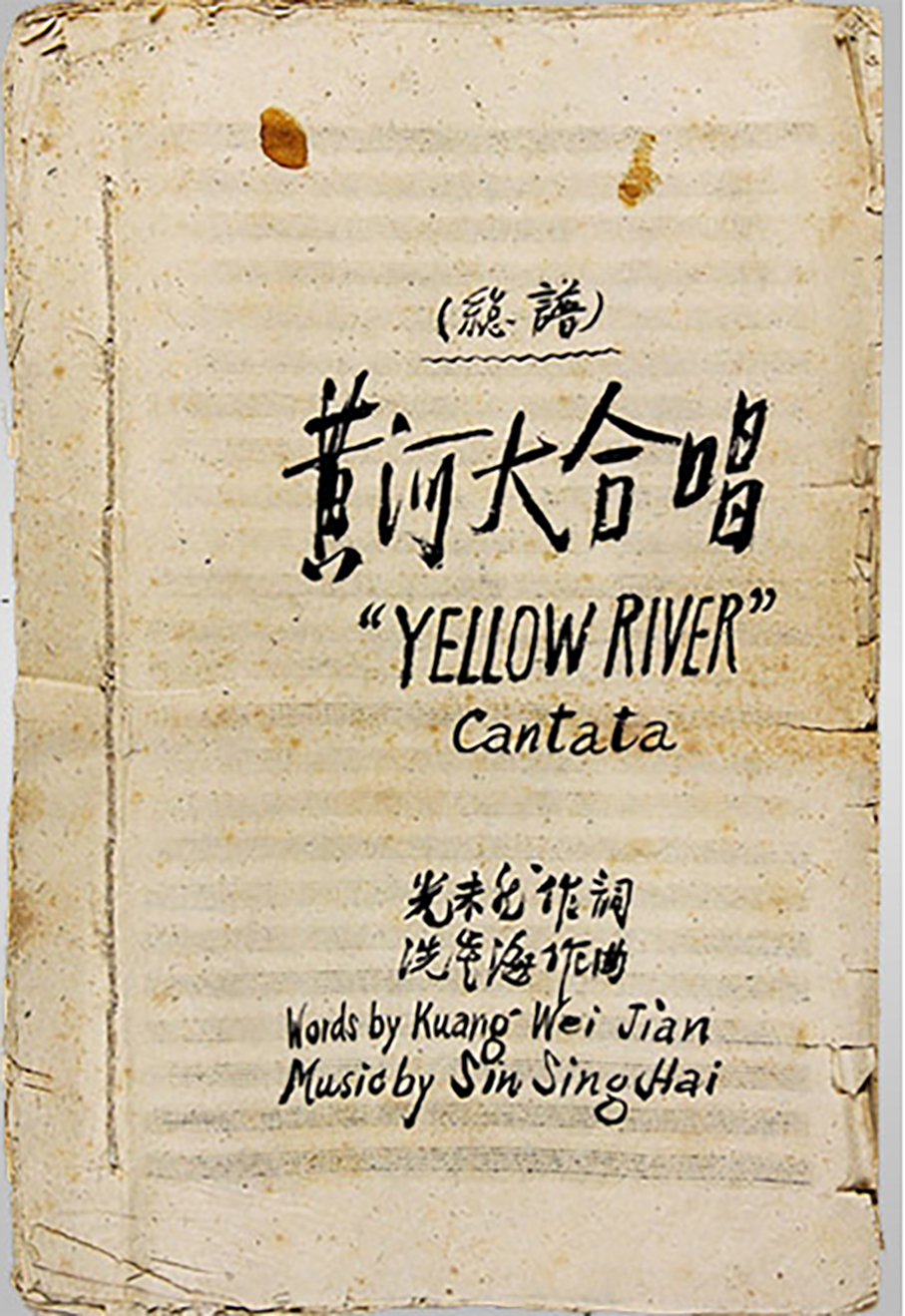
1944 copy of the original score of “Yellow River” Cantata by Xiang Xinghai – Image courtesy of moj.gov.cn/Wikimedia Commons
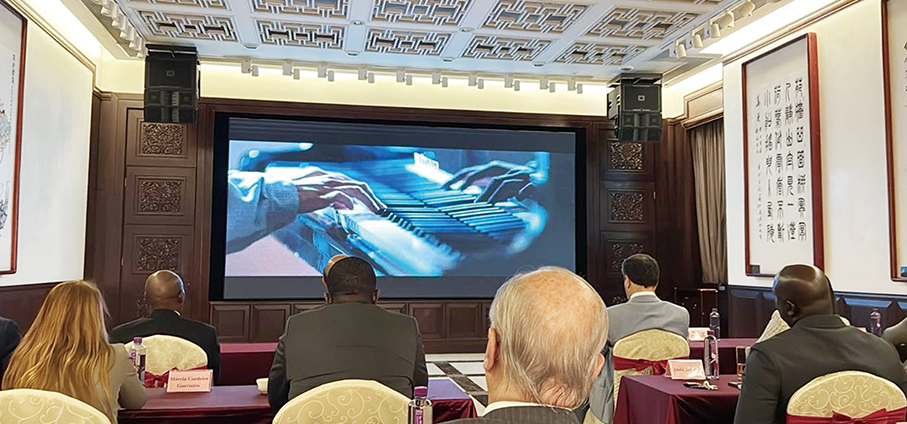
Foreign trade reps, journalists and academics watch Friday’s screening of “The Composer” at the Foreign Ministry Commissioner’s Office in Nape on Friday.